Showing posts with label economics. Show all posts

Thursday, December 20, 2012

Starbucks cuts staff benefits to fund avoided tax!


The Law of Unintended Consequences strikes again!

From the Guardian   - http://www.guardian.co.uk/business/2012/dec/03/starbucks-slash-lunch-breaks

"Starbucks is cutting paid lunch breaks, sick leave and maternity benefits for thousands of British workers, sparking fresh anger over its business practices.
On the day the House of Commons' public accounts committee branded the US coffee chain's tax avoidance practices "immoral", baristas arriving for work were told to sign revised employment terms, which include the removal of paid 30-minute lunch breaks and paid sick leave for the first day of illness. Some will also see pay increases frozen.
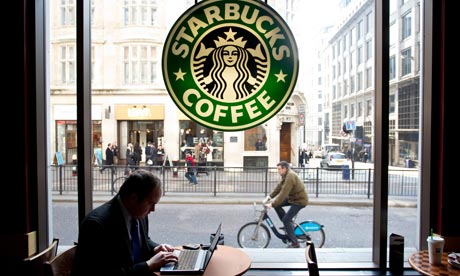
Starbucks coffee shop in Monument, LondonThe changes affecting about 7,000 coffee shop staff emerged as thecompany tried to quell public and political outrage at its use of secretive company structures that has seen it pay just £8.6m in UK tax over the past 13 years on sales of £3.1bn.
On Saturday Starbucks announced it would open talks with the UK government that could lead to it paying more tax in future and on Monday it was reported that such an announcement could come on Wednesday. But at the same time it was telling workers it was removing benefits and changing employment arrangements.
The new contractual terms being circulated to staff across 750 stores include the removal of cash incentives for becoming manager or partner of the year in favour of the award of a plaque and the removal of a bonus scheme for women returning after they have had a baby because "it is not considered a valued benefit".
A worker who claimed he was told to sign the new contract last week or leave, told the Guardian colleagues were "really upset" at the changes and said it appeared relatively low-paid staff were being forced to help bear the cost of the company's potentially increased tax bill.
"It's really convenient for them to say we're going to pay more taxes, when they're going to save money with us, the staff," said the coffee shop worker on condition of anonymity. "It's convenient saying we'll pay more because they're going to save more – and the perfect excuse for them is to say to staff 'We're going to pay more taxes, so…'."
He said his manager explained Starbucks "is losing a lot of money in Europe, so they said they needed to make these changes to save the company money".
Even apparently minor benefits are being cut. Starbucks is ending the practice of giving hampers to new mothers in favour of "a card and Starbucks baby grow and bib". The new policy on staff birthdays orders: "Removal of birthday cards. Bakery good code to be issued in store for free birthday treat." Congratulations cards on the anniversary of the first four years of service are being withdrawn."

Sunday, December 16, 2012

Mao's "Great Leap Forward" resulted in great famine

From - 

‘Tombstone’ by Yang Jisheng, translated from the Chinese by Stacy Mosher and Guo Jian - http://www.bostonglobe.com/arts/books/2012/11/03/review-tombstone-the-great-chinese-famine-yang-jisheng-translated-from-chinese-stacy-mosher-and-guo-jian/yuFFCEmLIxORRuesm3LjXI/story.html

"Mao’s Great Leap Forward, designed to make China the world’s leading communist state, generated the worst famine in history. Until recently, the West knew little about the causes and magnitude of the disaster, which killed tens of millions in four years.

“Tombstone” looks at the Chinese famine of the mid-1900s.

As a veteran Chinese journalist, Yang Jisheng recounts in his book “Tombstone” how for decades officials blamed “natural calamity” for the massive population loss; references were made to epidemics, “and no mention of starvation was allowed.” Yang has conducted a sweeping investigation and amassed information from dozens of archives to produce a comprehensive history of the Great Chinese Famine. He intended his book as a monument to the millions of victims, including his own father.
The original two-volume version of “Tombstone,’’ double the size of the English edition, appeared in 2008 in Hong Kong and has already run to eight printings. The book is banned in mainland China where no full famine account has ever been published, “an offense to the memories of tens of millions,” writes Yang.
Frank Dikötter, a Hong Kong-based historian, was the first to disclose to the West the true dimensions of this man-made tragedy. In his 2010 award-winning “Mao’s Great Famine: The History of China’s Most Devastating Catastrophe, 1958-62’’ Dikötter holds Mao responsible for the deaths of 45 million people, who were starved and beaten to death in pursuit of a utopian paradise.
“The masses are slaves,” a party cadre was quoted as saying, “and they won’t do anything unless beaten, berated, or deprived of food.” Local cadres had unlimited power to rape, ransack homes, deny food, beat and kill those who stole out of hunger or those not blindly obeying. The draconian system generated waste and destruction. Peasants received inflexible commands about plowing depth for seeding and planting density, directives that lead to crop failure.An admirer of Stalin, Mao imposed collectivization and industrialization on backward China, emphasizing high production targets and speed. But unlike Stalin, he mobilized peasants to work in both agriculture and industry, turning the entire country into a vast gulag. Millions of private farms across China were forcibly consolidated into gigantic communes, the state seizing private land and assets without compensation; opponents were beaten and killed. Private property was seen as an impediment to communism; about 40 percent of all housing was destroyed. The regime sanctioned an unprecedented persecution of peasants across China, their lives sacrificed to unworkable goals dictated by the supreme leader.
Mao promoted people’s communes, which allowed for an extraordinary concentration of state power. By putting every aspect of peasant lives under the party’s control the system created conditions for the famine. By the end of 1958, 90 percent of the rural population was forced to take meals in communal canteens; cooking implements were confiscated. When supplies ran out and kitchens closed, peasants were left without the means to survive.
Unrealistically high production targets and procurement quotas were the key elements that generated the famine. Faced with political pressure, the cadres exaggerated crop yields. When the myth of peasants hiding grain was created, army detachments were sent to extort every kernel.
At the Lushan Conference of 1959 Mao was made aware that his economic policies had “descended into chaos,” causing starvation. Instead of changing direction, Mao defeated “the anti-party clique” and purged his prominent critic, China’s defense minister Peng Duhai. After the conference Mao’s policies were intensified, extending the impact of the Great Famine.
Party secretaries never traveled to the countryside where desperation was total and cannibalism rampant. To cover up evidence of the famine local cadres had mass graves stomped flat and crops planted on top. With millions dying, the cadres entertained at lavish feasts and had meals delivered to luxury hotels. Survivors remember: “We were swollen with starvation, while the cadres were swollen with overeating.” Officials responsible for millions of deaths were merely transferred to other bureaucracies — unfairly, as some of them judged, since they merely acted on party orders.
Yang’s book can be compared with Solzhenitsyn’s “The Gulag Archipelago,” since its evidence was also bravely collected under Communism with the goal of helping dismantle the totalitarian system that had sanctioned mass killings. This system has outlived itself, writes Yang, who believes China should disavow its Communist ideals and erect memorials to the victims of the Great Famine."

Thursday, November 29, 2012

Less youth gets jobs with job scheme!

From - The Guardian - http://www.guardian.co.uk/politics/2012/nov/27/work-programme-long-term-jobs

"Only 3.5% of people referred to Work Programme find long-term jobs

None of welfare-to-work scheme's 18 contractors reached target of getting 5.5% of clients a job for at least six months

Unemployment in Britain: why our job centres aren't working
An analysis by the Guardian reveals that none of the 18 Work Programme contractors – 15 of which are private companies – managed to get 5.5% of unemployed people referred to the scheme a job for half a year in the 14 months until July 2012, despite the government having spent £435m on the scheme so far. Providers are paid for taking on a jobless person, finding them a job and then ensuring they keep it.
Ingeus, part of a multinational founded by the wife of the former Australian prime minister Kevin Rudd, is the biggest private contractor, winning seven franchises of the programme worth £727m over five years. In the north-east of England, Ingeus was referred almost 28,000 jobless people and got 920 into sustained employment, a success rate of 3.3% until July 2012. A4e, which is the second biggest contractor to the programme, with £438m of deals, found 490 jobs for 17,650 unemployed people in the south of England – a performance rate of 2.8%.
Mark Hoban, the employment minister, told a press conference he would be writing to companies to warn them they were falling short of the government's targets, and reminding them if they had not improved by next April he could begin to divert the jobless from poor performers to the best companies.
...
Hoban said the figures had to be considered "against the backdrop of much weaker than expected growth. We had been expecting growth of 2 or 2.5% a year by now."
The Department for Work and Pensions (DWP) had threatened to remove contracts from providers who failed to meet minimum performance levels, which look at the first 12 months of the Work Programme. If this measure is used then just 2.3% of jobseekers found sustained work compared with the 5.5% minimum expected by the DWP.
...
The Labour leader, Ed Miliband, pointed out that long-term unemployment had soared by more than 200,000 since the scheme began. He said the work programme was a "miserable failure. It's just not working because over the first year of the Work Programme just over two in every hundred people have been getting a job. And estimates are that if the Work Programme didn't exist five in every hundred would be getting a job."

Britain's millionaire tax backfires

From - The Telegraph - http://www.telegraph.co.uk/news/politics/9707029/Two-thirds-of-millionaires-left-Britain-to-avoid-50p-tax-rate.html

"Two-thirds of millionaires left Britain to avoid 50p tax rate

Almost two-thirds of the country’s million-pound earners disappeared from Britain after the introduction of the 50p top rate of tax, figures have disclosed.

George Osborne, the Chancellor, announced in the Budget earlier this year that the 50p top rate will be reduced to 45p from next April.
George Osborne, the Chancellor, announced in the Budget earlier this year that the 50p top rate will be reduced to 45p from next April.  Photo: Getty
In the 2009-10 tax year, more than 16,000 people declared an annual income of more than £1 million to HM Revenue and Customs.
This number fell to just 6,000 after Gordon Brown introduced the new 50p top rate of income tax shortly before the last general election.
The figures have been seized upon by the Conservatives to claim that increasing the highest rate of tax actually led to a loss in revenues for the Government.
It is believed that rich Britons moved abroad or took steps to avoid paying the new levy by reducing their taxable incomes.
George Osborne, the Chancellor, announced in the Budget earlier this year that the 50p top rate will be reduced to 45p from next April.
Since the announcement, the number of people declaring annual incomes of more than £1 million has risen to 10,000.
However, the number of million-pound earners is still far below the level recorded even at the height of the recession and financial crisis.
Last night, Harriet Baldwin, the Conservative MP who uncovered the latest figures, said: “Labour’s ideological tax hike led to a tax cull of millionaires.
Far from raising funds, it actually cost the UK £7 billion in lost tax revenue."

Wednesday, October 24, 2012

As China tensions simmer, Japan pulls back from "world's factory"


China may have encouraged its citizens to protest against perceived Japanese incursions into Chinese maritme territory. These protests resulted in burnt Japanese car showrooms in China nd other acts of violence. The unintended consequence may be a speeding up of Japanese investment away from China to more peaceful and increasingly less costly countries.

From Reuters - http://www.reuters.com/article/2012/10/23/us-japan-china-firms-idUSBRE89M1GS20121023


"Almost a quarter of Japanese manufacturers are rethinking their investment plans in China and some may shift future production elsewhere after the spike in tensions between Asia's two largest economies."

The sentiments were expressed in a Reuters Corporate Survey released on Wednesday and in interviews conducted in recent weeks with executives in industries ranging from electronics to apparel manufacturing.


The concerns suggest the recent rift between China and Japan over disputed islands in the East China Sea could mark the end of a boom that has played out over two decades in which Japanese companies have emerged as the most active source of outside direct investment in China after Hong Kong and Taiwan.

Since 1990, Japanese companies led by electronics makers like Panasonic Corp (6752.T) and followed by a wave of automakers like Nissan Motor Corp (7201.T) and Toyota Motor Corp (7203.T) and their suppliers have poured almost $1 trillion into Chinese factories, Japanese government statistics show.

The investment by over 20,000 firms created over 1.6 million jobs as Japanese companies looked to take advantage of low production costs and then China's potential as a surging market for everything from cars to cosmetics.

Now, sentiment has turned. When asked if their attitude toward using China as a production hub over the medium term had changed, 37 percent of Japanese companies surveyed said they had grown more cautious.

Almost half of Japanese manufacturers said they expected to see lower sales in the current fiscal year. In response to a separate question, 24 percent said they were considering delaying or reducing planned investment in China. Eighteen percent said they were considering shifting production to other countries.

The survey allowed companies responding to pick more than one choice to describe the impact of the China dispute on their business, meaning there could be some overlap between the group of manufacturers considering cutting investment and those looking to other markets outside China as future production hubs.

"China is very convenient, but gradually that convenience has been fading," Yoshihisa Ejiri, 65, president of clothing chain Honeys Co (2792.T) told Reuters.

The Reuters survey of 400 Japanese companies took place between October 1 and October 17. A month earlier, almost 60 percent of firms in a Reuters survey said they expected little to no fallout from the strains with China. Companies were not asked if they were considering delaying or reducing planned investment in China in that poll.

"The level of the anti-Japan demonstrations was different this time and I think that will make it harder for companies that have been successful in China to continue operating there," said Hisayoshi Hashimoto, a professor at Japan's National Graduate Institute for Policy Studies."

Tuesday, October 2, 2012

Little venture, little gain

Isn't it ironic that companies world-wide are hoarding cash because they fear that the recession will be with us much longer; but the very act of hoarding $4 trillion cash instead of spending it in employment, expansion, acquisitions is causing the unintended consequence of prolonging the recession?

If a mere layman like me can see that, why can't the smart captains of industry and commerce?

You wonder.

From - http://www.thetimes.co.uk/tto/business/industries/banking/article3555319.ece#tab-5 -


Storm-tossed economic seas have prompted company directors worldwide to pick up their shovels, head for shore and bury their bulging business cashpiles.
Risk-averse boardrooms are hoarding about $4 trillion while they wait for the clouds to break, according to a study of the world’s top 500 non-financial businesses by the law firm Hogan Lovells.
Misery in Europe, a slowdown in the pace of Chinese growth and only a tepid recovery in the United States have contributed to a culture of corporate inaction. Hogan Lovells found low activity both in dealmaking and in distributing cash to shareholders.
“It’s tempting to see this as encouraging because you feel, sooner or later, that something’s going to need to be done with all this money,” Andrew Pearson, a corporate partner at Hogan Lovells, said.
American companies top the hoarders’ league, having set aside $1.8 billion, citing political uncertainty before next month’s presidential election as their biggest reason for inaction. German businesses have amassed $259 billion, while French companies have put aside $228 billion as the eurozone crisis rages. Britain’s top companies have $147 billion of cash on their balance sheets — almost as much money as the NHS’s annual budget.

Friday, September 21, 2012

Bond wars: Chinese advisor calls for Japanese bond dump

From China Daily Mail - http://chinadailymail.com/2012/09/21/bond-wars-chinese-advisor-calls-for-japanese-bond-dump/


"China is actively considering “using its power as Japan’s biggest creditor with $230bn (£141bn) of bonds to “impose sanctions on Japan in the most effective manner” and bring Tokyo’s festering fiscal crisis to a head.” Meaning: dump Japan’s bonds en masse.
Should this stunning recommendation be enacted, not only would it be the first time in world history that insurmountable credit is used as a weapon of retaliation, it would mark a clear phase transition in the evolution of modern warfare: from outright military incursions, to FX wars, to trade wars, culminating with “bond wars” which could in the span of minutes cripple the entire Japanese fiscal house of cards still standing solely due to the myth that unserviceable debt can be pushed off into perpetuity.
Further complicating things is that Japan has no clear means of retaliation: it owns no Chinese bonds of its own it can dump as a containment measure. Instead, Japan is at best left with the threat of damages incurred on the Chinese economy should Japan be lost as a trading partner. It appears, however, that to China such a gambit is no longer a major concern:
Mr Jin said China can afford to sacrifice its “low-value-added” exports to Japan at a small cost. By contrast, Japan relies on Chinese demand to keep its economy afloat and stave off “irreversible” decline.
“It’s clear that China can deal a heavy blow to the Japanese economy without hurting itself too much,” he said. It is unclear whether he was speaking with the full backing of the Politburo or whether sales of Japanese debt would do much damage. The Bank of Japan could counter the move with bond purchases. Any weakening of the yen would be welcome.
Ironically, this terminal bond war escalation would also mean that Japan’s last ditch alternative is to threaten the US with dumping America’s bonds in turn if the US i) does not step up on behalf of Japan and ii) if Japan is forced to promptly convert debt from one denomination into another. The fallout effect would be most dramatic.
It is unclear if China will proceed with this “scorched bond” step: should this happen there is likely no turning back as it would force a market test of the entire developed world."
We hope this is merely 'sabre rattling'. Nobody knows how the Law of Unintended Consequnces will play out if China does carry out its threat: global economic meltdown, a new Sino-Japanese war which then draws in USA and Russia, followed by EU and North Korea; South Korea, Taiwan and then WW3, ???

Wednesday, September 5, 2012

China’s Bridge Collapse: Infrastructure Boom Raises Safety Questions


From: http://world.time.com/2012/08/27/bridge-collapse-in-china-raises-questions-about-safety-of-countrys-road-construction-boom/
On Sunday, 47 people died in two traffic accidents, highlighting the danger of China's overcrowded and poorly maintained roads
Four trucks fell to the ground after a section of the Yangmingtan bridge collapsed in Harbin early Friday morning, killing three people and injuring five others on Yangmingtan Bridge in Harbin, China on Aug. 24 2012

OP PHOTO CORPORATION / REX
Four vehicles fell after a section of the Yangmingtan Bridge in Harbin collapsed on Aug. 24, 2012, killing three people and injuring five others
China’s roads are notoriously dangerous. That point was reiterated Sunday as 47 people died in two traffic accidents, including 36 who were killed in Shaanxi province, when a sleeper bus rear-ended a tanker truck loaded with methanol, and another 11 who died in a collision in Sichuan province. The weekend’s road death toll was startling, but the collisions had a grim familiarity: loaded vehicles colliding on rural highways, apparently due to driver negligence, with horrible consequences. Indeed, Monday morning saw yet another crash between a van and a truck that killed at least nine. So perhaps it was understandable that much of the domestic media attention focused on an accident that had a comparatively small death toll but raised the specter of a growing concern on China’s roads: the parlous state of the infrastructure itself.
In the northeastern city of Harbin a bridge ramp collapsed on Friday, killing three and injuring five. The collapse was particularly shocking because the Yangmingtan Bridge was built at a cost of $300 million less than a year ago, raising questions about whether corners were cut in its construction. The bridge failure was blamed on overloaded trucks, but the government is now carrying out a more detailed investigation into the cause. Chinese newspaper editorials and online comments have called for answers as to why the bridge collapsed and who should take responsibility. Harbin officials were forced to deny claims that they couldn’t track down the contractors who built the bridge and said the names would be made public after an official investigation concluded.
The collapse is particularly worrisome because it follows several similar recent infrastructure failures. The Beijing News reports it was at least the seventh bridge to collapse in little over one year. That follows a building boom, driven in part by the economic-stimulus package launched in late 2008. More than a third of the $586 billion package was budgeted for infrastructure development. With a huge population and years of economic growth, China often seems to be bursting at the seams. Its roads, trains and subways are frequently overcrowded, and infrastructure development is sorely needed. The government says it plans to increase the nation’s highway system by 50% from 2 million km in 2008 to 3 million km in 2020. In places like the southern province of Guizhou, China’s poorest region, the stimulus helped the construction of the Baling River Bridge, which shortened the traverse of a river valley from an hour on winding roads to a matter of minutes. Around Beijing, mountain villages now enjoy smooth new highways linking them to the city center. But the Chinese capital’s infrastructure hasn’t aged gracefully. Heavy rainfall in July killed at least 77 people in Beijing — 11 of them drowned as their vehicles were trapped in flooded roadways. Sinkholes have sprouted around the city. Rural highways in the Fangshan district, which was hardest hit by flooding, and the Pinggu district, north of town, still have large sections missing a month after the deluge.
The sudden collapse of the Harbin bridge has raised questions about corruption and possible shortcuts taken in an effort to build so much so quickly. While the risk of crashes on China’s roads is numbingly constant, the fear of road collapses is a new and dramatic worry that likely outstrips the actual danger. “This is the national condition,” Li Chengpeng, a journalist and commentator, wrote on his blog on Monday. “I’ve seen a lot of people are now worried about their safety crossing bridges, wishing each one would have a Spider-Man underneath guarding it.” Similar questions were raised last year about China’s rapid expansion of its high-speed rail network after a crash near the city of Wenzhou killed 40. That accident was blamed on a lightning strike, but the safety of the system as a whole was called into question by the earlier dismissal of the Railway Minister Liu Zhijun for corruption.
The Law of Unintended Consequences strikes again. China spent billions on infrastructure projects after the 2008 global financial crisis to avert slowdown in China.  It seemed to have worked. But less than five years later the cracks (pun intended) are beginning to show in somewhat dramatic and dreadful ways.

Sunday, August 26, 2012

The law of unintended consequences - defined

Although I have submitted several posts on this blog, I realise that I have never properly defined "The Law of Unintended Consequences". So, belatedly, here is my offer from Rob Norton - Rob Nortonhttp://www.econlib.org/library/Enc/UnintendedConsequences.html

"The law of unintended consequences, often cited but rarely defined, is that actions of people—and especially of government—always have effects that are unanticipated or unintended. Economists and other social scientists have heeded its power for centuries; for just as long, politicians and popular opinion have largely ignored it.


The concept of unintended consequences is one of the building blocks of economics. Adam Smith’s “invisible hand,” the most famous metaphor in social science, is an example of a positive unintended consequence. Smith maintained that each individual, seeking only his own gain, “is led by an invisible hand to promote an end which was no part of his intention,” that end being the public interest. “It is not from the benevolence of the butcher, or the baker, that we expect our dinner,” Smith wrote, “but from regard to their own self interest.”
Most often, however, the law of unintended consequences illuminates the perverse unanticipated effects of legislation and regulation. In 1692 the English philosopher John Locke, a forerunner of modern economists, urged the defeat of a parliamentary bill designed to cut the maximum permissible rate of interest from 6 percent to 4 percent. Locke argued that instead of benefiting borrowers, as intended, it would hurt them. People would find ways to circumvent the law, with the costs of circumvention borne by borrowers. To the extent the law was obeyed, Locke concluded, the chief results would be less available credit and a redistribution of income away from “widows, orphans and all those who have their estates in money.”
============================
See also Wikipedia entry: http://en.wikipedia.org/wiki/Unintended_consequences