The invasion of Iraq, which was meant to rein in Muslim extremism and 'rogue' Muslim rulers, resulted in the unintended consequence of the so-called Arab Spring.
The Arab Spring was meant to free Muslim countries from despots and the like. One of the unintended consequences was the rebellion against Assad in Syria.
The West, having learnt from Iraq, largely decided not to intervene. The unintended consequence ios, of course, the spreading of ISIS from Iraq to Syria.
The bombing of the Russian tourist 'plane over Egypt was meant by ISIS to warn off Russia and weaken its support of Assad. The unintended consequence is the increase activity of Russia.
Similarly, the terrorist attack in Paris was intended to warn off Western powers. Instead France is fully engaged and there are signs that the UK may join them and Russia and the US.
Given the universal application to the law of unintended consequences, God (and He alone) knows where all this will lead.
Showing posts with label unintended consequences. Show all posts
Showing posts with label unintended consequences. Show all posts
Friday, November 27, 2015


Thursday, July 3, 2014
Google Removes Robert Peston's BBC Article Because Someone Wanted It 'Forgotten'
Instead of being 'forgotten', the item has been re-tweeted many, many times!
From: http://www.huffingtonpost.co.uk/2014/07/03/google-right-to-be-forgotten-robert-peston_n_5553880.html

From: http://www.huffingtonpost.co.uk/2014/07/03/google-right-to-be-forgotten-robert-peston_n_5553880.html
Robert Peston woke up to an eyebrow-raising email from the search engine giant this morning, informing him his work had been eradicated from history, complying with new measures that require sites to honour the "right to be forgotten" online.
His blog post about former Merrill Lynch boss Stan O'Neal, published almost seven years ago on the BBC website, is now unsearchable in Google. Peston said that this effectively means that no one will see the blog post from now on.
“To all intents and purposes the article has been removed from the public record, given that Google is the route to information and stories for most people,” he wrote.
The reporter has now asked why he was being "cast into oblivion" by the search engine.
A landmark European court decision in May said Google must listen and sometimes comply when individuals ask it to remove links to newspaper articles or websites containing personal information.
The "right to be forgotten" is based on the premise that outdated information about people should be removed from the internet after a certain time.
Google sent Peston the following message:
Notice of removal from Google Search: we regret to inform you that we are no longer able to show the following pages from your website in response to certain searches on European versions of Google
Perston's article described how O'Neal was forced to leave the investment bank after it endured significant losses on the back of careless investments.
Blogging on the matter yesterday Peston accused Google of having "killed this example of my journalism", but conceded that the technology giant had opposed the court ruling.
The latest blog, which links to the 2007 article, was last night shared on Peston's Twitter feed and retweeted more than 500 times.
The journalist said he did not know who had requested the removal of the story, entitled "Merrill's mess", from the search engine, declaring it "all a bit odd".
He said: "Maybe I am a victim of teething problems. It is only a few days since the ruling has been implemented - and Google tells me that since then it has received a staggering 50,000 requests for articles to be removed from European searches."
Speaking shortly after the ruling in May, Google spokesman Al Verney said it was ''disappointing ... for search engines and online publishers in general''.
Peston, who said he was "rather shocked" to be told that the article was being removed from search results, said that it was "completely possible" the complaint could have come from any of the readers who commented on the post or were named in the comments, rather than in the story itself.
But the journalist said it was still possible to find web pages Google had been asked to remove from European searches.
He told BBC Radio 4's Today programme: "Because this only applies in Europe, because this is an EU ruling, if you put in google.com/ncr that basically means you are not searching the regional version of Google and even if you are in the UK you can still find anything.
"So it sort of makes a whole nonsense of the ruling, to be honest."
Google informed Peston that since the rule came into force it has received around 50,000 removal requests, and that it has hired "an army of paralegals" to process them. Peston has contacted Google to ask if he can appeal against the blocking of his article. He is currently awaiting a response.
Sunday, March 2, 2014
Chinese Employers Discriminate Against Women Planning to Have Two Children
From: http://www.businessweek.com/articles/2014-02-28/chinese-employers-discriminate-against-women-planning-to-have-two-children
Late last year, China’s central government announced reforms to the controversial one-child policy—in particular, approving a resolution that would allow couples to have two children if at least one of the parents was an only child. But the change didn’t go into effect instantly; implementation is controlled locally. On Tuesday,Shanghai’s government approved measures to enact the so-called two-child policy, effective March 1. Shanghai is the seventh region in China to adopt guidelines for reforming, not abolishing, the country’s sprawling population-control bureaucracy.
To some extent, the number of children couples can have—and when they can have them—will vary by city. Shanghai’s policies are more liberal than Beijing’s, where new guidelines took hold last Friday. Shanghai parents qualified to have two children can do so regardless of their own ages or the time between births. But Beijing parents with one child must wait until the mother turns 28, or the first child turns 4, before having a second child, as independent newsmagazine Caijingreported.
China’s relaxed birth-control policies also bring unexpected consequences. According to state-run Global Times, some female job applicants are already facing increased hiring discrimination as potential employers appear reluctant to pay for two maternity leaves. “An interviewer asked me if I was going to have two children, and I did not know how to answer,” one young woman in Zhejiang province told the newspaper. “Having children is also making a contribution to society, but they [potential employers] treat us like enemies, which is so unfair.”
Monday, July 15, 2013
Hello 3D printing, goodbye China
If the following article's predictions do come true, then the world economy as we know it today will be destroyed as the unintended consequence. No trucks, freight trains, container ships, no major manufacturing facilities, no major hub warehouses. No truck and freight train drivers, no container ship crews, no depot warehousemen. No truck, freight train, container ship manufacturers; less construction workers and companies. I wonder ...
From: http://www.thesundaytimes.co.uk/sto/business/Tech_and_Media/article1287518.ece?CMP=OTH-gnws-standard-2013_07_14
From: http://www.thesundaytimes.co.uk/sto/business/Tech_and_Media/article1287518.ece?CMP=OTH-gnws-standard-2013_07_14
A SPECTRE is haunting the great container ship ports of China, with their highways jammed by lorries and the vast factory estates stretching from the coast of the South China Sea to the mountainous inland provinces.
It is the spectre of a revolution led by a quiet, software-driven 3D printer, a machine that can laser up layers of liquid or granular resin — or even cell tissue — into a finished product.
Some 3D printers are huge devices that make complete components such as aircraft parts. Others are small units that could stand next to a desk and create a small plastic prototype.
Maplin, the British electronics retailer, said last week it would start selling one for just £700. The Velleman K8200 will allow those who are so inclined to make simple objects — mobile phone covers, perhaps, or toys.
“The only restriction is your imagination. You can make whatever you want,” said Pieter Nartus, export manager at Velleman.
To visionaries in the West, the digital 3D printer promises to disrupt conventional manufacturing and supply chains so radically that advocates compare its impact to the advent of the production line, or the internet.
In China, whose big factories are thinking of using giant 3D printers for manufacturing, the technology does not seem to pose an immediate threat.
“It is on their horizon but it is not a factor right now,” says a British buying agent who sources plastics in China.
However, as Chinese leaders ought to know from their compulsory classes in Karl Marx, control of the means of production is everything. And if 3D printing takes off, production will come back to a place near you.
The implications, economists say, are limitless. No huge factories. No fleets of trucks. No ships. No supply chain. No tariffs. Few middlemen. Orders tailored exactly to demand, so no need for stock and warehouses. Just a printer, raw materials, software and a design.
The advantages do not end there. Because the item is “sintered” — created from a powdered material — to precise settings using a laser, there is no waste such as metal shavings. To customise a product, the user simply changes the software. An operator presses a button and the printer spits out the item.
“The first implication is that more goods will be manufactured at or closer to their point of purchase or consumption,” said Richard D’Aveni, a professor at Dartmouth College in America.
Writing in the Harvard Business Review, D’Aveni predicted the elimination of the long supply chain linked to a huge factory staffed by cheap workers and sited on the other side of the world.
It may be the most significant, if underplayed, article in that distinguished publication in decades.
Not surprisingly, 3D manufacturing has been dismissed by the boss of the biggest factories of them all, Terry Gou of Foxconn, which employs more than 1m Chinese workers making consumer electronics for Apple, Sony, Samsung, Nintendo and other household names in technology.
Foxconn has used some elements of industrial 3D printing for three decades but Gou says it is commercially impractical for mass production.
“3D printing is a gimmick,” he told reporters in Taiwan, where Foxconn is based. “If it really is that good, then I’ll write my name backwards from now on.”
Foxconn and its clients are still smarting from publicity over a chain of suicides at the company’s vast plants, where young employees live under heavy security and work to a strict management regimen on the production line.
Conditions on Chinese assembly lines, as in Bangladeshi garment workshops, have long concerned advocates of workers’ rights.
But it may not be the workers who ultimately overthrow the system. The use of 3D printing implies a transformation that persuades hard-headed economists such as D’Aveni that companies like Foxconn might just become obsolete.
“China has grabbed outsourced manufacturing contracts from every mature economy by pushing the mass-manufacturing model to its limit,” he wrote. “It not only aggregates enough demand to create unprecedented efficiencies of scale but also minimises a key cost: labour.
Watch a demonstration of the £700 Velleman K8200 printer, on sale at Maplin
“Under a model of widely distributed, highly flexible small-scale manufacturing, these daunting advantages become liabilities. No workforce can be paid little enough to make up for the costs of shipping across oceans.”
According to the British buyer, who provided a cost breakdown on a commercially confidential basis, a Chinese factory typically gets between 6p and 7p from a plastic product sold in Britain for £1. That includes its labour costs and profit.
Raw materials, shipping and ground transport add 24p to bring the landed price at a port in southern England to 31p.
The product will sell to the retailer for about 45p, handing the wholesaler a profit of 14p. The retailer marks the product up to £1 but the Treasury helps itself to 20p VAT, leaving the retailer a profit of 35p.
In the brutal war for margin amid volatile commodities and currencies at the bottom end of the market — where China has carved its niche — the numbers tell their own ominous story. In a world of 3D manufacturing, the classic supply chain makes no commercial sense.
“China won’t be a loser in the new era,” D’Aveni argued in the Harvard Business Review. “It will have a domestic market to serve . . . and its domestic market is huge. But China will have to give up on being the mass-manufacturing powerhouse of the world.”
China, of course, is not sitting still. It is eagerly buying western 3D printing technology and making its own lightweight machines to sell to consumers. The ministry of industry and information technology has already allocated £20m to fund 10 research centres and set up a group of 40 participating companies.
In May, Beijing hosted the World 3D Printing Technology Industry Conference. Luo Jun, head of a Chinese trade body, told the state media that the domestic 3D industry will generate about £1.1bn in revenues within three years.
Luo Zheng, sales manager of Renishaw, a Shanghai company, said Chinese firms were at present forced to buy large industrial printers made in Britain at a cost, he said, of about £650,000 each.
Nor has China yet mastered the complex chemistry of 3D inks and resins, so it is dependent on imports.
However, observers who have spent many years watching how China operates in world markets don’t expect such dependence to last.
Caixin, a business magazine, reports that a mechanical engineering professor at Tsinghua University, Yan Yongnian, first brought American 3D technology to China in the 1980s.
This year a research team at Beijing University, led by Wang Huaming, a professor of materials science and engineering, won an award for 3D innovation in aviation components from the State Council, China’s cabinet. The country’s military aviation industry is already using the technology. It is employed in making the J-16 fighter and the next-generation J-31, according to Huanqiu, a website linked to the Global Times. Scientists have used it to make critical load-bearing titanium components, including strengthened landing gear for planes that will be operating from aircraft carriers.
In June, Dalian University of Technology in northeast China unveiled the world’s largest 3D printer. According to Professor Yao Shan of the university, the industrial-grade machine also uses a cheaper form of print material that can cut operating costs by 40%.
In the medical field, researchers at Shining 3D Tech, a company based in Zhejiang province, showed off an artificial disc implant that can fuse with human cell tissue to avoid rejection. The company predicts that one day the technology could be used to manufacture human skeletons from cell tissue and biomaterial.
So there is no doubt about China’s scientific, engineering and intellectual commitment to 3D manufacturing.
However, it is a fundamentally different concept in China. To the Chinese, it is an industrial tool to be used in making more things to sell.
To western economies that are hooked on cheap imports with a huge carbon footprint, it could be a means of transformation — perhaps even an agent of de- industrialisation.
That conceptual divergence has led to a tone of complacency in some quarters in China. “Some western media said 3D technology will benefit the West, help American industry recover and attack China’s position as the factory of the world,” said Jia Jinjing, a management researcher, before adding: “I do not support this view.”
In an interview with a Chinese magazine, Environment and Livelihood, Jia said: “3D can make only a single-material product and it cannot print electronic components. Therefore 3D technology will not have a big impact on Chinese manufacturing.”
In the West, one very important person disagrees. In February, President Barack Obama declared that 3D technology could “guarantee that the next revolution in manufacturing is made in America”.
The fate of thousands of companies and millions of employees in the two biggest economies will depend on who is right.
Thursday, June 6, 2013
The Unintended Consequences of China's Ultra High-Stakes College Entrance Exam
This week, millions of high school students in China will take the dreaded gaokao, the country’s college entrance exam. It’s much more important than the SAT: Admission to most Chinese colleges is based wholly ongaokao scores, and if a student performs poorly, he or she has to wait a full year to have another shot. Because there are more college graduates than good jobs in China, if you don’t go to one of the leading universities, the chances of getting a stable and secure job after graduation are precarious. A bad gaokao score can seal your fate.

Last Friday, I had dinner with Yu Xiubo, a Chinese scientist in Beijing, and his son Raphael, who is studying electrical engineering at a state university in the U.S. and was back in China for summer break. It’s rare to get to talk to a father and son together about the changing aspirations of two different generations in China, and while every family’s story is singular, theirs seemed particularly interesting at the beginning of this very important week of gaokao.
Raphael’s decision to pursue college in the U.S. began with his low score on the gaokao. (On the topic of China’s tightening job market for college graduates, the state-runGlobal Times newspaper has just published this depressing chart.)
Raphael didn’t have to tell his parents his score. His father retrieved it online the day scores were released in late June 2011. For a student at one of Beijing’s top high schools, his score was very disappointing. Worse, he had flopped the science section—because he budgeted time poorly, he says, not because he didn’t know the answers. His only option was to enroll at a far-flung university in northeastern China, with little chance of getting back to a job in Beijing, where his parents live and where he had, until then, imagined his future.
Instead of fretting about it, Raphael, who is clearly a very bright, extroverted, and resourceful young man, spent his next year enrolled at a university in the northern city of Harbin and focused on learning about the admissions process for U.S. colleges. A growing number of high school students in China are now skipping the gaokao and applying directly to overseas universities, and Raphael had some friends who had been through the process. (Currently, one in four foreign university students in North America hail from China; enrollment by Chinese students has risen steeply over the past decade.)
In mainland China, there is no testing site for the SAT, so Raphael went to Hong Kong. Of the 10 colleges he applied to in the U.S., he was accepted by two—and he selected the one in the more bucolic setting, befitting his idea of what college in America should be. At his university, fully half of the international students (5 percent of the total student body) are from China.
The awareness of how much his family is spending on his college education—financial aid is generally not available to overseas students—has changed his perception of what he should do next. “I have to make my education pay off,” he says. Instead of aiming for a job in Beijing, he’s now hoping to work in Silicon Valley. He’s been following the news about visa-policy debates in the U.S. and thinks his decision to pursue a degree in a STEM field (science, technology, engineering, mathematics) helps his chances to get a green card. Eventually, he hopes to help his family apply for residency in the U.S. “My No. 1 goal is to do better in life than my father,” he says. “My father brought the family to Beijing, and I will bring the family to America.”
Sunday, May 19, 2013
Western leaders study 'gamechanging' report on global drugs trade
If one of the main unintended consequences of the war on drugs is to increase criminality and the trafficking of drugs, will removal of the prohibition lead to a better world? Or will it have its own unintended consequences?
From - http://www.guardian.co.uk/politics/2013/may/18/drugspolicy-drugs-trade
In an open letter, former Latin American leaders call for legal regulation to help undermine organised crime
From - http://www.guardian.co.uk/politics/2013/may/18/drugspolicy-drugs-trade
In an open letter, former Latin American leaders call for legal regulation to help undermine organised crime
After more than four decades of a failed war on drugs, calls for a change in strategy are growing louder by the day. In Latin America, the debate is positively deafening. Statesmen from Colombia, Guatemala, Mexico and Uruguay are taking the lead for transformations in their own drug regime, which has set a strong dynamic of change across the region and around the world. Their discussion has expanded to the US, where public opinion toward regulation is also changing.
For the first time, the majority of Americans support regulated cannabis for adult consumption. Nowhere has this support been more evident than in Colorado and Washington, states that recently approved new bills to this effect. This shift in public opinion presents a direct challenge to the US federal law, but also to the United Nations drug conventions and the international drug policy regime.
The Global Commission on Drug Policy, building on the call for a paradigm shift formulated by the Latin American Commission on Drugs and Democracy, has called loudly for precisely these kinds of changes since 2011. Twenty global leaders have highlighted the devastating consequences of repressive drug policies on people, governance and economies not just in Latin America, but around the world.
Our flagship report – War on Drugs – sets out two main recommendations: (i) replace the criminalisation of drug use with a public health approach, and (ii) experiment with models of legal regulation designed to undermine the power of organised crime. By brokering a genuinely global conversation on drug policy reform, we broke a century-old taboo.
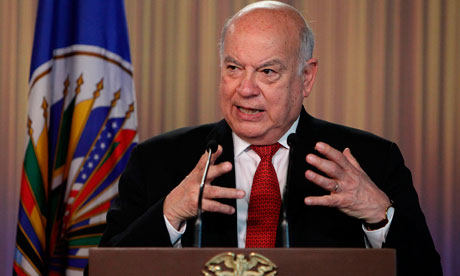
A new unexpected voice was added to the debate on drug policy reform. The Secretary General of the Organization of American States (OAS) José Miguel Insulza presented Colombian President Santos with the findings of a much anticipated report on alternative scenarios for drug control and regulation for the Americas. The study itself was originally the idea of Santos and endorsed by all heads of American states at the 2012 Summit of the Americas in Cartagena.
The OAS-backed study proposes four possible scenarios for future drug policy reflecting an emerging consensus across Latin America. Fortunately, none of the scenarios call for the status quo. Most experts endorse the first three scenarios – the shift from repressive approaches to ones that privilege citizen security, the experimentation with different approaches to regulating illegal drugs, and the strengthening of community resilience. Obviously, all serious leaders agree that the fourth scenario, the threat of creating narco-states, is to be avoided at all costs. Taken together, the report represents the first comprehensive treatment of drug policy reform from a multilateral organisation.
The OAS study sets out complementary, rather than mutually excluding paths. They are based on the realistic expectation that demand for psychoactive substances will continue to exist over the coming decade and that only a small proportion of users will become dependent. In fact, many states are already decriminalising drug use and experimenting with cannabis regulation, while also investing in harm reduction programmes including the medical supply of harder drugs. Rather than causing problems as predicted by their critics, they are generating positive and measurable results.
The OAS and countries across Latin America are positively contributing to the breaking of the taboo that blocked for so long the debate on more humane and efficient drug policy. It is time that governments around the world are allowed to responsibly experiment with regulation models that are tailored to their realities and local needs. The leadership demonstrated by President Santos and the OAS secretary general is welcomed. But the report is just the start – leaders across the Americas need to take this study seriously and consider how their own policies can be improved. In doing so, they will be breaking the vicious cycle of violence, corruption, and overcrowded prisons and will put people's health and security first.
Fernando Henrique Cardoso
former president of Brazil, chair
Cesar Gaviria
former president of Colombia
Ricardo Lagos
former president of Chile
George P. Shultz
former Secretary of State, United States, honorary chair
Paul Volcker
former Chairman of the United States Federal Reserve and of the Economic Recovery Board
Louise Arbour
former UN High Commissioner for Human Rights, President of the International Crisis Group
Ernesto Zedillo
former president of Mexico
Driverless cars, pilotless planes … will there be jobs left for a human being?
From - http://www.guardian.co.uk/technology/2013/may/19/driverless-cars-pilotless-planes-jobs-human
Throughout history, economic upheaval has destroyed whole industries – and created new ones. But now, some fear automation may mean the death of mass employment.in

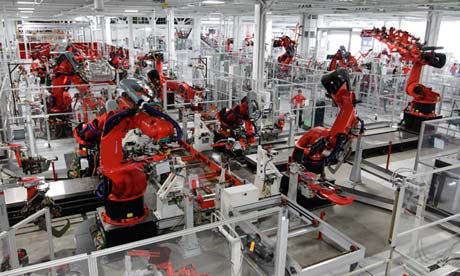
The future of jobs? Robots assembling Tesla sports cars in California. Photograph: Paul Sakuma/AP
Suddenly a robotised, automated economic reality is moving off the science fiction pages and into daily life. The growing use of unmanned battlefield drones is encouraging the growth of pilotless commercial aircraft – the first ever flew in British airspace last month. Google's driverless car is completing ever more trials ever more successfully: the world's major car companies are all hot in pursuit, working on their own prototypes of their own versions. The automated checkouts at supermarkets are becoming as familiar as bank cash machines. From staff-free ticket offices to students who can learn online, it seems there is no corner of economic life in which people are not being replaced by machines.
This is the "Great Reset" – a cull of broadly middle-class jobs with middle-class incomes that is apparent across the west, but with little current sign of what industries and activities will replace them.
The world has lost millions of jobs before – on the land or in the old horse-powered economy – but they were soon replaced by jobs in the car industry or the new service industries. What worries many economists and computer scientists is that today's technologies are going to remove people from economic activity completely. Some argue that a dystopian world is emerging in which good jobs and full-time employment will become the preserve of an educated, computer-literate elite. For example Apple, Facebook, Amazon and Google are plainly riding the new wave, but they are not mass employers like Tesco, Ford or General Motors.
Moshe Vardi, a computer scientist at Rice University, asks if we are ready for a world in which half the adult population does not work. The Great Reset – the economy resetting itself, after a major technological shock, to deliver jobs for all – may never happen.
The omens are all around. The US economy has never generated so few jobs in an upturn since records began. In Britain, the Resolution Foundation charts the ongoing squeeze on low and middle incomes, and observes brutally that already Britain has the second highest proportion of low-paid jobs in the developed world. The formal unemploymentnumbers, now ominously rising five years since the crisis began, do not capture the full extent to which the economy is not delivering good work.
Plainly some of the explanation is that the economy is still reeling from the effect of the financial crisis and the accompanying vast overhang of private debt. But economies have an embedded resilience. Output will return to the levels of 2008, probably some time next year. There will be an economic "recovery". But this raises the question: what happens afterwards?
Think through the implications of the driverless car. These will be vehicles whose complex sensors allow them to communicate with one another, so that they know one another's intended route. One of the reasons Google is investing so much is that whoever owns the communications system for driverless cars will own the 21st century's equivalent of the telephone network or money clearing system: this will be a licence to print money. The benefits are endless. Roads will both be able to carry more traffic and be safer. Personalised door-to-door transport will become hugely pleasurable: your car will deliver you to your home or place of work and then park itself without you. Road accidents will plummet. Energy efficiency will be transformed. Insurance rates, even the need for insurance, will plunge. Personalised transport, ordered by your mobile phone, will gradually replace mass transport networks.
But the implications for employment are awesome. Thomas Frey, senior futurologist at the DaVinci Institute, lists taxi-, bus- and truck-driving as soon-to-be-extinct occupations – along with traffic police, all forms of home delivery and waste disposal, jobs at petrol stations, car washes and parking lots. The cars themselves will be made by robots in automated car factories. The only new jobs will be in the design and marketing of the cars, and in writing the computer software that will allow them to navigate their journeys, along with the apps for our mobile phones that will help us to use them better.
Professor Larry Summers, former US treasury secretary, thinks that the challenge of the decades ahead is not debt or competition from China but the dramatic transformations that technology is bringing about. Summers believes that the transition to the automated economy that robotisation implies has only just begun. The invention of 3D printing, in which every home or office will be equipped with an in-house printer that can spew out the goods we want – from shoes to pills – anticipates a world of what Summers calls automated "doers". They will do everything for us, eliminating the need for much work. The only jobs will be in writing the software and building the "doers", creating a bifurcation of the labour market that is already discernible.
At least Summers sees some underlying economic dynamism. For techno-pessimists such as economist Professor Tyler Cowen the future is even darker. It is not only that automation and robotisation are coming, but that there are no new worthwhile transformational technologies for them to automate. All the obvious human needs – to move, to have power, to communicate – have been solved through cars, planes, mobile phones and computers. According to Cowen, we have come to the end of the great "general purpose technologies" (technologies that transform an entire economy, such as the steam engine, electricity, the car and so on) that changed the world. There are no new transformative technologies to carry us forward, while the old activities are being robotised and automated. This is the "Great Stagnation".
That is a very lopsided view of the future with little recognition of the opportunities. The growth of transformative technologies is not tailing off: as scientific knowledge explodes and crosses new boundaries, they will accelerate. The 21st century will witness more technological and scientific advance than in the last 500 years. The pace of change is certainly accelerating – business models today already become obsolescent in less than 20 years, and that figure is going to fall further. But human demands are infinite. Notwithstanding robotisation and automation, I identify four broad areas in which there will be vast job opportunities.
The first is in micro-production. There is going to be a huge growth in micro-brewers, micro-bakers, micro-film-makers, micro-energy producers, micro-tailors, micro-software houses and so on who will deploy the internet and micro-production techniques to produce goods at prices as if they were mass-produced, but customised for individual tastes.
The second is in human wellbeing. There will be vast growth in advising, coaching, caring, mentoring, doctoring, nursing, teaching and generally enhancing capabilities. Medical provision will explode, with replacement organs, skin and limbs opening up new specialisms and industries. Taste, sight and hearing will be vastly enhanced. Ageing will be deferred, with old-age advisers offering advice on how to live well in one's hundreds. Geneticists will open up a live-well economy. Instantaneous language translation will break down language barriers.
The third is in addressing the globe's "wicked issues" . There will be new forms of nutrition and carbon-efficient energy, along with economising with water, to meet the demands of a world population of 9 billion in 2050. Space exploration will become crucial to find new minerals and energy sources. New forms of mining will allow exploration of the Earth's crust. The oceans will be farmed.
And fourthly, digital and big data management will foster whole new industries – personalised journalism, social media, cyber-security, information selection, software, computer science and digital clutter removal.
Doubtless the futurologists can come up with more: the truth is, nobody knows. What we do know is that two-thirds of what we consume today was not invented 25 years ago. It will be the same again in a generation's time. What is different is the pace of change, obsolescence and renewal – and new dangers of extraordinary inequality not just in wages, but in working possibilities. Firms and individuals will be on their mettle to open up, innovate and constantly reinvent themselves. If there is to be a successful Great Reset, Britain will need the open innovation structures, financing mechanisms and social support institutions to capitalise on the opportunities quickly, rather than be overwhelmed by the risks.
This is what threatens our future, our living standards, and this is what we should be arguing about – not the European Union, despite the efforts of Ukip and the Conservative party. Those whom the gods wish to destroy they first make mad.
Wednesday, January 23, 2013
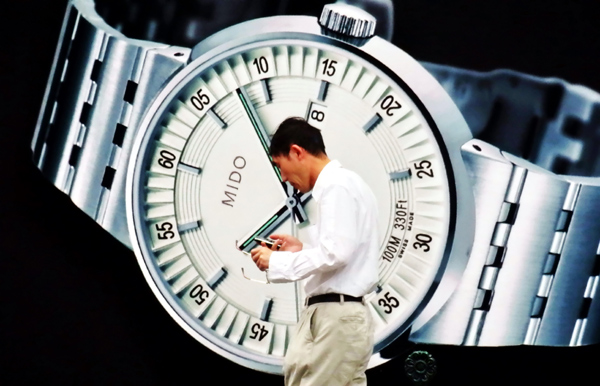
Corruption curbs crimp luxury market
 |
Thursday, January 17, 2013
United States and Japan began on Thursday the revision of defense cooperation guidelines
We hope that this revision does not fall onto the 'Law of Unintended Consequences' and exacerbates rather than alleviates the current high tensions.
Reuters: "The United States and Japan began on Thursday the revision of defense cooperation guidelines for the first time in 15 years as Prime Minister Shinzo Abe faces a territorial dispute with China and North Korea's missile and nuclear programmes.

The revision to the guidelines, which set rules on how Japanese and U.S. forces work together in or near Japan, comes after a hawkish Abe led his Liberal Democratic Party to power in an election last month.
"We would like to discuss Japanese Self Defence Forces' role and U.S. forces role with eyes on the next five, 10, 15 years and on the security environment during those periods," a Defence Ministry official told reporters, without elaborating.
The revision is due because of drastic changes in the security environment over the past 15 years including China's maritime expansion and North Korea's missile development, the Japanese government has said.
North Korea has also twice tested nuclear devices.
Japan is locked in a territorial dispute with China over a group of tiny East China Sea islets called Senkaku in Japan and Diaoyu in China, with both countries sending patrol ships and planes to areas near the isles.
The review started with a working-level meeting in Tokyo between U.S. and Japanese officials. It will likely take a year or more to complete and coincides with a U.S. "pivot" in diplomatic and security focus to Asia.
"One issue that's prevalent is whether the Abe government will reinterpret the constitution to exercise the right of collective self defence," said Nicholas Szechenyi, senior fellow at the Center for Strategic and International Studies.
"Should that policy decision be taken, it will obviously have an impact on the way the Self Defence Forces and U.S. military coordinate."
Japan recognizes it has what is known as the right of collective self-defence, meaning a right to defend with force allies under attack even when Japan itself is not being attacked.
But Japanese governments have traditionally interpreted the pacifist constitution as banning the actual exercise of the right, creating a sore spot in Tokyo's security ties with Washington. Abe wants to change the interpretation to allow Japan to exercise the right.
See also: http://chindia-alert.org/2012/08/12/beijing-reasserts-its-claims-in-south-china-sea-nytimes-com/
Monday, January 14, 2013
United States, China, and India: Unintended consequences of great power politics
Author: Franz-Stefan Gady is a Senior Fellow at the EastWest Institute.

October 2012 marked the 50th anniversary of the 1962 Sino-Indian War. Communist China launched a surprise attack across the Himalayas to “teach India a lesson”, according to the Chinese Premier, Zhou Enlai.
After 32 days of fighting and embarrassing Indian defeats, the Chinese announced a unilateral ceasefire and withdrew behind the McMahon Line (the de-facto boundary between China and India, although legally disputed by the People’s Republic of China).
To this day, the 1962 war is seen as a national humiliation in India
Scanning the Op-Ed sections of newspapers while I was in New Delhi in October this year, the general consensus of commentators and political analysts appeared to be that the war, like no other event in post-colonial Indian history, was a unifying force in bringing the country together. It led to the modernization of the Indian Army, and made India temporarily abandon its isolationist, non-aligned foreign policy outlook, and forced it to accept military aid from Western Powers and the Soviet Union, ultimately setting the stage for a more assertive Indian foreign policy.
India’s slow ascent to great power status
Diplomatic historians may mark the 1962 war as the beginning of India’s slow ascent to great power status and a force to be reckoned with in 21st century Asian power politics. Yet, to this day, India’s foreign policy is – more than most other emerging titans – constrained by a quest for internal security and a deep introspection – making it a reluctant power and conducting a more or less “introverted foreign policy”.
Checking the growth of Chinese power in the region
The United States is trying to change India’s reluctant stance and is attempting to forge closer ties with New Delhi. During his visit in June 2012, U.S. Secretary of Defense, Leon Panetta, called India a “lynchpin” in the United States’ strategic pivot to Asia.
Behind all of this is the United States’ desire to check the growth of Chinese power in the region. As the former US Envoy to India, Robert D. Blackwill, pointed out in a speech in New Delhi in 2009: “President George W. Bush based his transformation of US-India Relations on the core strategic principle of democratic India as a key reason in balancing the rise of Chinese power.” Also he noted that: “[W]ithout this China factor at the fore in Washington, in my view the Bush Administration would not have negotiated the Civil Nuclear Agreement and the Congress would not have approved it.”
“Be careful what you wish for”
Yet, the United States should heed the maxim “be careful what you wish for.” For closer military and diplomatic ties between India and the United States may embolden India’s foreign policy, which could potentially destabilize the entire region of South Asia. As history teaches us, multi-cultural great powers often have a need to define their national identities by overarching national ‘exertions’ such as a war.
The current Indian National Security Advisor Menon referred to India as a ‘bridging power’ during an interview with Robert D. Kaplan for his book, Monsoon: The Indian Ocean and the Future of American Power.
Kaplan describes Menon’s rationale behind this statement: “[India]…is something between America and China, between a global power and a regional power, between a hard and soft power, between the emerging power of its economy and navy, and the poverty of its people and its weak borders.” Substitute India for Austria in the early 20th century and you have a historical case study of what the unintentional consequences of closer diplomatic ties with the supreme military of its time could entail.
India as ‘bridging power’?
The Austrian Empire, like India, was considered to be a bridging power between East and West for much of its existence. It was a multi-national empire, more concerned with its internal security and stability than with great power politics, and after humiliating defeats in 1859 and 1866, reluctant to use military power to meet its political goals (for most of the late 19th century-early 20th period it spent comparatively little on military defense).
As in the Sino-Indian war of 1962, these defeats lead to various military and political reforms culminating in the Austro-Hungarian compromise of 1867 and the establishment of a dual monarchy. Also, like India, Austria-Hungary was held together by an omnipotent, if slightly inefficient, bureaucracy.
Austria’s “Pakistan” in the 20th century was Serbia
Serbia, a small state in the Balkans trying to lure the South Slavic subjects of the empire to revolt through subversive means (as with Pakistan there was a clandestine connection between government circles and radical elements in the Serbian intelligence community).
Most importantly, Austria’s stance vis-à-vis Serbia was emboldened by its dual alliance with the German Empire, which in 1914 , after the assassination, gave Austria a diplomatic “Carte Blanche”, to deal once and for all with the “Serbian problem”.
Before this dual alliance, Austria always had to play a rather careful diplomatic game between East and West. The great protector power of Serbia was Russia, Austria’s powerful eastern neighbor threatening Austria’s exposed eastern borders. As the years progressed and tensions between the great powers mounted and the dual alliance solidified, Austria took an increasingly more aggressive stance against Serbia’s agitations.
In 1914, after the assassination of Archduke Ferdinand of Austria, Austria’s Chief of Staff, Conrad von Hoetzendorf’s, repeated requests for preventive war with Serbia was finally granted. Not before Austria, however, thought it had secured Germany’s guarantee to help defend its eastern borders, plunging all of Europe in the First World War.
India with similar problems?
India today faces many similar problems as Austria did in the early 20th century. A powerful peer competitor in the East (China) is conducting a relatively subtle anti-Indian South Asian policy and a smaller, but the more real subversive threat is coming from Pakistan and from continuing internal unrest in India.
Add the world’s strongest military power to this mix and the results could be explosive. According to various foreign policy experts in New Delhi, India is very aware of the delicate situation it occupies.
The United States would do well not to foster too close of a tie with India in the next few years of its strategic re-alignment to Asia. India has cautiously positioned herself between both parties in US-China competition. China has made it clear in many statements that it is not a threat to India, where India’s defense ministry clearly stated that India is not interested in containing China.
India’s diplomacy of peace and non-alignment is deeply felt and comes more naturally to it than war. In the near term the bigger danger of an emboldened India may well be an increase in crypto-nationalism and inter-communal extremism.
The Obama Administration should nevertheless carefully evaluate its relationship with India in the next four years and beware of the unintentional but often hazardous consequences of Great Power politics.
Subscribe to:
Posts (Atom)