Monday, July 9, 2012

Child trafficking in China - unintended consequence of one-child policy


NY Times: "The police have arrested 802 people on suspicion of child trafficking and have rescued 181 children in a major operation spanning 15 provinces, the Ministry of Public Security said Friday. The recent operation broke up two trafficking rings and led to the arrests of the ringleaders, the ministry said in a statement posted on its Web site. China’s strict one-child policy has driven a thriving market in babies, especially boys because of a traditional preference for male heirs."
'It is good to have only one child'


One of the unintended but direct consequences of the Chinese one-child policy.
See also: 

Sunday, June 24, 2012

War on drugs - a failure after 40 years

From The Observer - http://www.guardian.co.uk/world/2012/jun/23/mexico-elections-drugs-war:


"On 1 July, Mexicans will vote in vital presidential elections. But the issue no candidate dares to address is the cartel violence tearing the nation apart. Diplomats say the time has come to challenge drug policy – but can they get the US to agree? 

Mexico CityTwo policemen pass an anti-violence sculpture based on one made by Yoko Ono in memory of John Lennon, in Mexico City. Photograph: Ronaldo Schemidt/AFP/Getty Images

One after another, Mexico's presidential candidates sat in silence amid the grand setting of Chapúltepec Castle while, across the room, the leader of the country's movement of victims of drug war violence – a poet – chastised them.
"The 60,000 dead, the more than 20,000 who've disappeared, the hundreds of thousands of people displaced, wounded and hunted, the tens of thousands of widows and orphans that this stupid war against drugs is costing us, do not exist for you and your parties," Javier Sicilia accused. "For you, the national emergency does not exist." One after the other, the candidates promised action and showed concern, then they left. It was time to get back to the real business of running for president.
The meeting with Sicilia last month was unavoidable, given the moral weight of the movement he represents, but it was also the only time in the entire three-month campaign when the undisputed issue of the day was the drug war ravaging Mexico.
Polls show that most Mexicans consider security, along with the economy, to be the two biggest issues facing their country, but neither has featured particularly heavily. "Everybody asks me where the security issue is. Why the candidates don't talk about the economy. The elephant in the room is President Felipe Calderón's record, and that is hardly talked about," says pollster Jorge Buendía. In Ciudad Juárez, which has just lost its title as the world's most dangerous city, now ranked second, the chronicler of the violence, journalist Julián Cardona, says: "To look at the candidates speak, you would think they were talking about another country."
But whatever the politicians' speeches, Mexicans know that the country must take urgent measures now to try to put an end to the appalling violence if it is to claim the place in the world its economy justifies. And although Mexico is umbilically tied to the US war on drugs, and fights on the frontline of that war, senior Mexican diplomatic officials suggest to theObserver in private that, whoever wins the election, this must change; that there must be a major rethink and a shift towards initiatives in Latin America that challenge the "war on drugs" to which the US remains committed."
Since President Nixon declared war on drugs in 1971, Mexico and other Latin American countries have pitched in together with the US Drugs Enforcement Agency.  But drug consumption in the West is higher than ever and drug-related crime in these countries is one of the highest categories of crime.
This is another example of the Law of Unintended Consequences.

Friday, June 22, 2012

Special tax incentives lead to tax 'avoidance'

A recent hot issue in the UK is that of tax avoidance (which I am informed is legal and different from tax evasion which is not) practised by practically anyone with a reasonable income - http://www.thetimes.co.uk/tto/money/tax/article3453189.ece - an article in London Times lists " From dentists to doctors and financiers to footballers, through lawyers, dressmakers and an award-winning baker: investors in tax-efficient schemes read like an A to Z of working Britain."

The reason most of these tax avoidance schemes work is because of complex tax legislation that from time to time favours investments in one activity or another.  Over the years these range from encouraging investments in forests (green!) to films and music (culture and arts?) and so forth.

These schemes seem worthwhile and important at the time, but the legislators obviously know little about the Law Of Unintended Consequences.


Wednesday, June 13, 2012

If the Euro € is the answer, what was the question?


When the Euro € was created and introduced in January 1999, the belief was that those European countries who adopted the Euro to replace their national currency would find currency and economic stability; a case of shared strength, where the strong would bolster the weak.


Little did these countries know then that shared strength in the wrong circumstances turns into shared weakness, where the weak spread their weakness to the strong - a clear case of unstable equilibrium my old physics teacher would have said.

First Ireland, then Portugal, followed by Greece, maybe Spain and today, Germany warned Italy that if it did not follow the austerity measures of its government, it too would succumb.  http://www.reuters.com/article/2012/06/13/us-eurozone-idUSBRE85B0FT20120613?feedType=RSS&feedName=topNews&utm_source=feedburner&utm_medium=feed&utm_campaign=Feed%3A+reuters%2FtopNews+%28News+%2F+US+%2F+Top+News%29&utm_

Or, in terms of this blog, a clear case of the Law of Unintended Consequences.

Saturday, May 26, 2012

China's one-child policy


The Times, London: "The dance floors are polished to a shine and a 150-metre long “love wall” has been erected down the middle of the venue: everything is set for 48 hours of intensive matchmaking.In a now annual tumult of desire and desperation, more than 20,000 singles will descend on Expo Park in Shanghai today in pursuit of a spouse. A majority will be women: educated, salaried, urbanised and disappointed that city life has yet to yield Mr Right.


The event’s organisers assured The Times that a local steelworks and other Shanghai companies rich in male employees had been “encouraged to dispatch bachelors to the scene”. That urgent call for men is an anomaly in a country where a vast gender imbalance has become endemic and which some demographers believe will create a 50 million-strong surplus of single males by the end of the decade. Chinese families already have an instinctive grasp of the supply and demand crisis that lies ahead for young men. In poorer parts of the country, young men in their 20s are preparing unhappily for a long life unshared.

As well as being held on a greater scale than in the past, today’s event in Shanghai has a fresh innovation: singles will enter free, but parents accompanying them will be charged 50 yuan (£5). The deterrent effect will be minimal. Many thousands of parents are expected to attend, cajoling their offspring towards marriages that modern life is increasingly delaying. Plenty of the parental harassment is an old-fashioned wish for stability and grandchildren. But increasingly, the angst in China is born of raw economic fear. ...
China’s male surplus will pose unprecedented challenges to the incoming leadership of the Communist Party. No government anywhere has dealt with an imbalance on this scale. Li Jianmin, the head of the Institute of Population and Development Research at Nankai University, said that the difficulty of men finding wives was an effect of the “big backdrop” of a birth-sex ratio of 118 boys to 100 girls. “The gender imbalance trend started showing in the early 1980s, and now we have just walked over the threshold. In five to ten years, the high-risk period will come,” he said. He added that China’s family planning policy was to a great extent responsible for the imbalance. About 90 per cent of Chinese couples would like a boy and a girl, but when forced to have only one, most opt for a boy.

The problems of male oversupply will be further amplified if, as some now fear, China’s economy sputters. In places of high bachelor concentration, high unemployment, and where all hope of marriage has evaporated, there will probably be crime and unrest, said Andrea Den Boer, a demographer whose Bare Branches book warns of long-term security implications. “It is difficult to be optimistic because while China knows that this problem exists, it does not appear to have any plan,” she said. “There is a strong potential building for future violence and unrest and so far the Chinese authorities have not developed a response to those issues, other than a violent one.”"

A natural if unplanned result of the one-child policy of the CCP. A necessity to keep the population down. But the leaders had not reckoned on the Chinese historical desire to have male heirs. Another instance of the Law of Unintended Consequneces

Thursday, May 24, 2012

Joanna Lumley's Gurkha campaign

From BBC News 31 July 2011: "Two years ago actress Joanna Lumley helped Gurkhas who retired before 1997 win the right to settle in the UK. Gurkha welfare groups and the Home office estimate that about 8,000 former soldiers and their families have since moved to Britain. But many have struggled in the UK, as the BBC's Alastair Lawson reports.
Ragprasad Purja (right) celebrating Joanna Lumley's victory in 2009

Nowhere can the influx of Gurkhas into Britain be more clearly seen than in the British military town of Aldershot.
The local authority estimates that one in 10 of the town's 90,000 residents comes from Nepal - many as a direct result of the campaign Ms Lumley helped lead.
If the British Gurkha Welfare Society (BGWS) is to be believed, Joanna Lumley's campaign has been a disaster, resulting in thousands of elderly and infirm Gurkha pensioners - most unable to speak English - living in poor accommodation and relying on state handouts to survive.
The actress herself has broken a strictly-observed silence over criticisms of her campaign to release a statement to the BBC.

Joanna Lumley's statement

Joanna Lumley
We should remember that there would be no Great Britain, no National Health Service and no welfare state were it not for the blood spilt by Gurkhas and others to protect this country in much darker and more dangerous times than those we face now.
Time and time again during the campaign ordinary people would stop me in the street and plead with me not to give up, as they could see that what we asked for on behalf of the Gurkhas was just and fair.
All other foreign and Commonwealth soldiers had the right to settle in Britain, regardless of the cost to this country: but only the pre-1997 retired Gurkhas were denied this right.
I joined the campaign because my father served as a regular soldier with the Gurkhas, and being a "daughter of the regiment" I understood more than most what sacrifices the Gurkhas and their families had made to protect this country from tyranny.
The British people are fair-minded, and they believe in loyalty to close friends. I am just grateful that I had a small part to play in helping these fine men and their families.
"Our campaign had moral right on our side," the statement said, "and the vast majority of the British public wanted the government to amend the law to allow Gurkhas to settle in the UK.
"Debts of honour are not easy to translate or quantify into pounds and pence, and some MPs have criticised our campaign for not considering the potential financial impact on the exchequer. Yet the government did consider this at the time, and decided that our campaign arguments vanquished the issues of pure cost."
Ms Lumley's supporters insist that her campaign successfully reversed decades of discrimination against older Gurkhas who fought for the British army yet were denied the right to retire in the UK.
But the BGWS argues that it would be far more cost-effective if retired Gurkhas were paid better pensions and encouraged to stay in Nepal rather than pursue the more expensive option of emigrating to the UK to take advantage of state pensions, housing benefit and free health care."
In our view, not only would it be more cost effective, but the retired Gurkhas would be much better off and happier.  A £ goes much, much further in Nepal than in Surrey!
This is another case of well intentions translated by the Lay of Unintended Consequences into something not quite what was intended.

Monday, May 21, 2012

Partition of British India


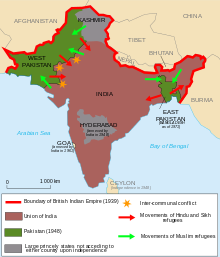
Before, during and soon after World War II, Britain realised it was time to quit India after nearly 300 years. Because of a perceived problem for the minority Muslim population as advocated by the leader of the Muslim League, Mr Jinnah, Britain decided that the safest option or the Muslim minority was to partition British India into India and two parts of Pakistan - West Pakistan and East Pakistan.  The latter being the eastern half of Bengal which had, for some strange reason a majority of Muslims.


There were several problem states: most concerned 'princely states' where the population was of one faith and the ruler of the other, such as Hyderabad a Hindu-majority state with a Muslim ruler. In all cases, common-sense prevailed and the ruler opted for the country which was geographically most sensible. But Jammu and Kashmir to the north had large Muslim majorities but with Hindu rulers. Unfortunately, the rulers couldn't decide by the given deadline. Consequently, Pakistan militarily took over the half nearest its borders and India the other half. As we know, the problem has yet to be resolved over 60 years after Independence.

But the worst problem was that despite the best intentions, partition directly caused the displacement  (to quote Wikipedia - http://en.wikipedia.org/wiki/Partition_of_India   "up to 12.5 million people in the former British Indian Empire, with estimates of loss of life varying from several hundred thousand to a million (most estimates of the numbers of people who crossed the boundaries between India and Pakistan in 1947 range between 10 and 12 million).[1] The violent nature of the partition created an atmosphere of mutual hostility and suspicion between India and Pakistan that plagues their relationship to this day."


See also - http://chindia-alert.org/historical-perspectives/2-2i-indias-20c-timeline/


The Law of Unintended Consequences struck again. One could even say that a variant: "The Law of Opposite to that Intended " struck.