Thursday, June 6, 2013

The Unintended Consequences of China's Ultra High-Stakes College Entrance Exam

This week, millions of high school students in China will take the dreaded gaokao, the country’s college entrance exam. It’s much more important than the SAT: Admission to most Chinese colleges is based wholly ongaokao scores, and if a student performs poorly, he or she has to wait a full year to have another shot. Because there are more college graduates than good jobs in China, if you don’t go to one of the leading universities, the chances of getting a stable and secure job after graduation are precarious. A bad gaokao score can seal your fate.
Students walk past a statue of Confucius as they step out of the testing room during day one of the 2012 College Entrance Exams in Wuhan, China
Last Friday, I had dinner with Yu Xiubo, a Chinese scientist in Beijing, and his son Raphael, who is studying electrical engineering at a state university in the U.S. and was back in China for summer break. It’s rare to get to talk to a father and son together about the changing aspirations of two different generations in China, and while every family’s story is singular, theirs seemed particularly interesting at the beginning of this very important week of gaokao.
Raphael’s decision to pursue college in the U.S. began with his low score on the gaokao. (On the topic of China’s tightening job market for college graduates, the state-runGlobal Times newspaper has just published this depressing chart.)
Raphael didn’t have to tell his parents his score. His father retrieved it online the day scores were released in late June 2011. For a student at one of Beijing’s top high schools, his score was very disappointing. Worse, he had flopped the science section—because he budgeted time poorly, he says, not because he didn’t know the answers. His only option was to enroll at a far-flung university in northeastern China, with little chance of getting back to a job in Beijing, where his parents live and where he had, until then, imagined his future.
Instead of fretting about it, Raphael, who is clearly a very bright, extroverted, and resourceful young man, spent his next year enrolled at a university in the northern city of Harbin and focused on learning about the admissions process for U.S. colleges. A growing number of high school students in China are now skipping the gaokao and applying directly to overseas universities, and Raphael had some friends who had been through the process. (Currently, one in four foreign university students in North America hail from China; enrollment by Chinese students has risen steeply over the past decade.)
In mainland China, there is no testing site for the SAT, so Raphael went to Hong Kong. Of the 10 colleges he applied to in the U.S., he was accepted by two—and he selected the one in the more bucolic setting, befitting his idea of what college in America should be. At his university, fully half of the international students (5 percent of the total student body) are from China.
The awareness of how much his family is spending on his college education—financial aid is generally not available to overseas students—has changed his perception of what he should do next. “I have to make my education pay off,” he says. Instead of aiming for a job in Beijing, he’s now hoping to work in Silicon Valley. He’s been following the news about visa-policy debates in the U.S. and thinks his decision to pursue a degree in a STEM field (science, technology, engineering, mathematics) helps his chances to get a green card. Eventually, he hopes to help his family apply for residency in the U.S. “My No. 1 goal is to do better in life than my father,” he says. “My father brought the family to Beijing, and I will bring the family to America.”

Sunday, May 19, 2013

Western leaders study 'gamechanging' report on global drugs trade

If one of the main unintended consequences of the war on drugs is to increase criminality and the trafficking of drugs, will removal of the prohibition lead to a better world?  Or will it have its own unintended consequences?

From - http://www.guardian.co.uk/politics/2013/may/18/drugspolicy-drugs-trade

In an open letter, former Latin American leaders call for legal regulation to help undermine organised crime
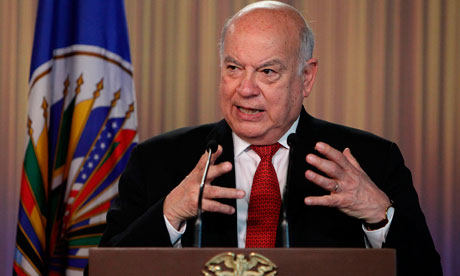
José Miguel Insulza


After more than four decades of a failed war on drugs, calls for a change in strategy are growing louder by the day. In Latin America, the debate is positively deafening. Statesmen from Colombia, Guatemala, Mexico and Uruguay are taking the lead for transformations in their own drug regime, which has set a strong dynamic of change across the region and around the world. Their discussion has expanded to the US, where public opinion toward regulation is also changing.
For the first time, the majority of Americans support regulated cannabis for adult consumption. Nowhere has this support been more evident than in Colorado and Washington, states that recently approved new bills to this effect. This shift in public opinion presents a direct challenge to the US federal law, but also to the United Nations drug conventions and the international drug policy regime.
The Global Commission on Drug Policy, building on the call for a paradigm shift formulated by the Latin American Commission on Drugs and Democracy, has called loudly for precisely these kinds of changes since 2011. Twenty global leaders have highlighted the devastating consequences of repressive drug policies on people, governance and economies not just in Latin America, but around the world.
Our flagship report – War on Drugs – sets out two main recommendations: (i) replace the criminalisation of drug use with a public health approach, and (ii) experiment with models of legal regulation designed to undermine the power of organised crime. By brokering a genuinely global conversation on drug policy reform, we broke a century-old taboo.
A new unexpected voice was added to the debate on drug policy reform. The Secretary General of the Organization of American States (OAS) José Miguel Insulza presented Colombian President Santos with the findings of a much anticipated report on alternative scenarios for drug control and regulation for the Americas. The study itself was originally the idea of Santos and endorsed by all heads of American states at the 2012 Summit of the Americas in Cartagena.
The OAS-backed study proposes four possible scenarios for future drug policy reflecting an emerging consensus across Latin America. Fortunately, none of the scenarios call for the status quo. Most experts endorse the first three scenarios – the shift from repressive approaches to ones that privilege citizen security, the experimentation with different approaches to regulating illegal drugs, and the strengthening of community resilience. Obviously, all serious leaders agree that the fourth scenario, the threat of creating narco-states, is to be avoided at all costs. Taken together, the report represents the first comprehensive treatment of drug policy reform from a multilateral organisation.
The OAS study sets out complementary, rather than mutually excluding paths. They are based on the realistic expectation that demand for psychoactive substances will continue to exist over the coming decade and that only a small proportion of users will become dependent. In fact, many states are already decriminalising drug use and experimenting with cannabis regulation, while also investing in harm reduction programmes including the medical supply of harder drugs. Rather than causing problems as predicted by their critics, they are generating positive and measurable results.
The OAS and countries across Latin America are positively contributing to the breaking of the taboo that blocked for so long the debate on more humane and efficient drug policy. It is time that governments around the world are allowed to responsibly experiment with regulation models that are tailored to their realities and local needs. The leadership demonstrated by President Santos and the OAS secretary general is welcomed. But the report is just the start – leaders across the Americas need to take this study seriously and consider how their own policies can be improved. In doing so, they will be breaking the vicious cycle of violence, corruption, and overcrowded prisons and will put people's health and security first.
Fernando Henrique Cardoso
former president of Brazil, chair
Cesar Gaviria
former president of Colombia
Ricardo Lagos
former president of Chile
George P. Shultz
former Secretary of State, United States, honorary chair
Paul Volcker
former Chairman of the United States Federal Reserve and of the Economic Recovery Board
Louise Arbour
former UN High Commissioner for Human Rights, President of the International Crisis Group
Ernesto Zedillo
former president of Mexico

Driverless cars, pilotless planes … will there be jobs left for a human being?


From - http://www.guardian.co.uk/technology/2013/may/19/driverless-cars-pilotless-planes-jobs-human

Throughout history, economic upheaval has destroyed whole industries – and created new ones. But now, some fear automation may mean the death of mass employment.

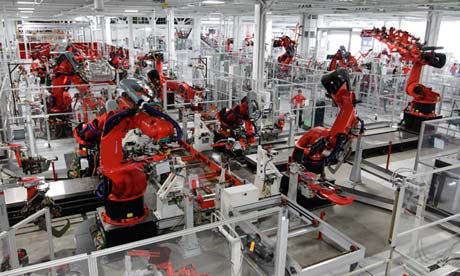
Robots assembling Tesla sports cars in California
The future of jobs? Robots assembling Tesla sports cars in California. Photograph: Paul Sakuma/AP
Suddenly a robotised, automated economic reality is moving off the science fiction pages and into daily life. The growing use of unmanned battlefield drones is encouraging the growth of pilotless commercial aircraft – the first ever flew in British airspace last month. Google's driverless car is completing ever more trials ever more successfully: the world's major car companies are all hot in pursuit, working on their own prototypes of their own versions. The automated checkouts at supermarkets are becoming as familiar as bank cash machines. From staff-free ticket offices to students who can learn online, it seems there is no corner of economic life in which people are not being replaced by machines.
This is the "Great Reset" – a cull of broadly middle-class jobs with middle-class incomes that is apparent across the west, but with little current sign of what industries and activities will replace them.
The world has lost millions of jobs before – on the land or in the old horse-powered economy – but they were soon replaced by jobs in the car industry or the new service industries. What worries many economists and computer scientists is that today's technologies are going to remove people from economic activity completely. Some argue that a dystopian world is emerging in which good jobs and full-time employment will become the preserve of an educated, computer-literate elite. For example Apple, Facebook, Amazon and Google are plainly riding the new wave, but they are not mass employers like Tesco, Ford or General Motors. 
Moshe Vardi, a computer scientist at Rice University, asks if we are ready for a world in which half the adult population does not work. The Great Reset – the economy resetting itself, after a major technological shock, to deliver jobs for all – may never happen.
The omens are all around. The US economy has never generated so few jobs in an upturn since records began. In Britain, the Resolution Foundation charts the ongoing squeeze on low and middle incomes, and observes brutally that already Britain has the second highest proportion of low-paid jobs in the developed world. The formal unemploymentnumbers, now ominously rising five years since the crisis began, do not capture the full extent to which the economy is not delivering good work.
Plainly some of the explanation is that the economy is still reeling from the effect of the financial crisis and the accompanying vast overhang of private debt. But economies have an embedded resilience. Output will return to the levels of 2008, probably some time next year. There will be an economic "recovery". But this raises the question: what happens afterwards?
Think through the implications of the driverless car. These will be vehicles whose complex sensors allow them to communicate with one another, so that they know one another's intended route. One of the reasons Google is investing so much is that whoever owns the communications system for driverless cars will own the 21st century's equivalent of the telephone network or money clearing system: this will be a licence to print money. The benefits are endless. Roads will both be able to carry more traffic and be safer. Personalised door-to-door transport will become hugely pleasurable: your car will deliver you to your home or place of work and then park itself without you. Road accidents will plummet. Energy efficiency will be transformed. Insurance rates, even the need for insurance, will plunge. Personalised transport, ordered by your mobile phone, will gradually replace mass transport networks.
But the implications for employment are awesome. Thomas Frey, senior futurologist at the DaVinci Institute, lists taxi-, bus- and truck-driving as soon-to-be-extinct occupations – along with traffic police, all forms of home delivery and waste disposal, jobs at petrol stations, car washes and parking lots. The cars themselves will be made by robots in automated car factories. The only new jobs will be in the design and marketing of the cars, and in writing the computer software that will allow them to navigate their journeys, along with the apps for our mobile phones that will help us to use them better.
Professor Larry Summers, former US treasury secretary, thinks that the challenge of the decades ahead is not debt or competition from China but the dramatic transformations that technology is bringing about. Summers believes that the transition to the automated economy that robotisation implies has only just begun. The invention of 3D printing, in which every home or office will be equipped with an in-house printer that can spew out the goods we want – from shoes to pills – anticipates a world of what Summers calls automated "doers". They will do everything for us, eliminating the need for much work. The only jobs will be in writing the software and building the "doers", creating a bifurcation of the labour market that is already discernible.
At least Summers sees some underlying economic dynamism. For techno-pessimists such as economist Professor Tyler Cowen the future is even darker. It is not only that automation and robotisation are coming, but that there are no new worthwhile transformational technologies for them to automate. All the obvious human needs – to move, to have power, to communicate – have been solved through cars, planes, mobile phones and computers. According to Cowen, we have come to the end of the great "general purpose technologies" (technologies that transform an entire economy, such as the steam engine, electricity, the car and so on) that changed the world. There are no new transformative technologies to carry us forward, while the old activities are being robotised and automated. This is the "Great Stagnation".
That is a very lopsided view of the future with little recognition of the opportunities. The growth of transformative technologies is not tailing off: as scientific knowledge explodes and crosses new boundaries, they will accelerate. The 21st century will witness more technological and scientific advance than in the last 500 years. The pace of change is certainly accelerating – business models today already become obsolescent in less than 20 years, and that figure is going to fall further. But human demands are infinite. Notwithstanding robotisation and automation, I identify four broad areas in which there will be vast job opportunities.
The first is in micro-production. There is going to be a huge growth in micro-brewers, micro-bakers, micro-film-makers, micro-energy producers, micro-tailors, micro-software houses and so on who will deploy the internet and micro-production techniques to produce goods at prices as if they were mass-produced, but customised for individual tastes.
The second is in human wellbeing. There will be vast growth in advising, coaching, caring, mentoring, doctoring, nursing, teaching and generally enhancing capabilities. Medical provision will explode, with replacement organs, skin and limbs opening up new specialisms and industries. Taste, sight and hearing will be vastly enhanced. Ageing will be deferred, with old-age advisers offering advice on how to live well in one's hundreds. Geneticists will open up a live-well economy. Instantaneous language translation will break down language barriers.
The third is in addressing the globe's "wicked issues" . There will be new forms of nutrition and carbon-efficient energy, along with economising with water, to meet the demands of a world population of 9 billion in 2050. Space exploration will become crucial to find new minerals and energy sources. New forms of mining will allow exploration of the Earth's crust. The oceans will be farmed.
And fourthly, digital and big data management will foster whole new industries – personalised journalism, social media, cyber-security, information selection, software, computer science and digital clutter removal.
Doubtless the futurologists can come up with more: the truth is, nobody knows. What we do know is that two-thirds of what we consume today was not invented 25 years ago. It will be the same again in a generation's time. What is different is the pace of change, obsolescence and renewal – and new dangers of extraordinary inequality not just in wages, but in working possibilities. Firms and individuals will be on their mettle to open up, innovate and constantly reinvent themselves. If there is to be a successful Great Reset, Britain will need the open innovation structures, financing mechanisms and social support institutions to capitalise on the opportunities quickly, rather than be overwhelmed by the risks.
This is what threatens our future, our living standards, and this is what we should be arguing about  – not the European Union, despite the efforts of Ukip and the Conservative party. Those whom the gods wish to destroy they first make mad.

Wednesday, April 10, 2013

In bitter irony for China, North Korea furthers U.S. strategic goals

From - http://www.reuters.com/article/2013/04/10/us-korea-usa-china-idUSBRE93903U20130410?feedType=RSS&feedName=topNews

Nobody but Kim Jong-un knows what he hopes to achieve with his saber-rattling campaign, but the young North Korean leader probably didn't set out to aid the United States, the sworn enemy of three generations of Kims, at the expense of his country's main ally, China.
A South Korean soldier sets up a barricade at a checkpoint on the Grand Unification Bridge, which leads to the demilitarized zone separating North Korea from South Korea, in Paju, north of Seoul April 8, 2013. REUTERS/Kim Hong-Ji
In a boon for U.S. policy that can only add to China's frustration with Kim, North Korean bellicosity has helped reinforce an American strategy of rebalancing its security policies toward the Asia-Pacific region.

To a China that often sounds more wary of Washington than of Pyongyang, months of North Korean missile and nuclear tests followed by a daily stream of bloodthirsty war threats may be worrisome, but the U.S. reaction is even more troubling.

"We understand what kind of regime North Korea is, but we also understand that North Korea is playing games," said Sun Zhe, director of the Center for U.S-China Relations at Beijing's Tsinghua University.

"Most importantly, we are complaining that the United States is using military drills as an excuse to continue to do this (rebalancing), putting up B-2s and other advanced weapons systems," he said.

B-2 and B-52 bombers, radar-evading F-22s and anti-missile system vessels like the USS John S. McCain represented the initial U.S. response to North Korea's repeated, explicit threats to launch nuclear strikes against the United States.

The U.S. also said it would shift THAAD (Terminal High Altitude Area Defense System) to defend Guam from missile attack. And Tokyo's Yomiuri Shimbun newspaper said Japan would permanently deploy Patriot Advanced Capability-3 (PAC-3) anti-missile systems in Okinawa to counter North Korean missiles.

Friday, March 15, 2013

UK 'whiplash capital of Europe'

The UK passed a law several years ago allowing lawyers to charge on results rather than a fee based on time spent.  Unfortunately, amongst many other unintended consequences is this one.


From: http://www.telegraph.co.uk/finance/personalfinance/insurance/motorinsurance/8522985/UK-whiplash-capital-of-Europe.html

Insurers have called for a clampdown on fraudulent whiplash claims which they say are driving up the cost of motor cover for honest motorists.

Rear-end shunts often result in costly claims for whiplash
Rear-end shunts often result in costly claims for whiplash Photo: ALAMY
The Association of British Insurers (ABI) said the UK was now the "whiplash capital of Europe", with one out of every 140 people claiming for a whiplash injury each year.
It said the activities of ambulance chasing lawyers and claims management firms, as well as staged "cash for crash" accidents, were driving up the number of claims.
Whiplash occurs when the soft tissue in the spine is stretched and strained following a sudden forceful movement, such as being hit from behind in a car.
But it is often difficult to diagnose, while it is easy to fake or exaggerate, making claims for the injury a target for fraudsters.
Around 1,200 whiplash claims are made in the UK every day, six times more than the number of people who claim for workplace related injuries each year.

Record number of Americans buying guns, new FBI figures show


From http://www.guardian.co.uk/world/2013/feb/05/fbi-us-gun-control-record-number-buying

More than 2.4m gun background checks were initiated in January, topped only by last December's 2.7m

guns US
'America is crazy for guns,' says Pam Bosley, mother of a young student shot dead in Chicago. 'We love guns more than life.' Photograph: Elaine Thompson/AP
Americans are lining up to buy guns in unprecedented numbers in the wake of the Newtown school shooting and the debate around tightening gun controls, with federal background checks on prospective buyers running at record levels.
New figures released by the FBI show that 2,495,440 gun background checks were initiated in January. That is the second highest number since records began in 1998, and is exceeded only by the entry for December 2012, which reached a peak of 2,783,765.

Beans means bonanza as oil frackers turn demand for guar into gold rush


The Times: "Just as America’s booming shale gas industry has helped to wean the country off an unhealthy dependence on imported Middle Eastern oil, a new national addiction is emerging — to the Indian guar gum on which the industry depends.
A merchant paints numbers on sacks of guar as a laborer loads them onto a truck at a grain market in Jodhpur, India

Soaring demand for guar from US oil companies — whose apparently insatiable appetite stems from its use in making the drilling fluids used in the process of hydraulic fracturing or “fracking” for shale gas — triggered a 374 per cent surge in Indian exports between January 2011 and January 2012.
With 80 per cent of global production of guar — which means cow feed in Hindi — India has a near monopoly on the bean, a fact that has led to a bonanza for Indian farmers who witnessed a ninefold increase in prices during 2012. “The price increase has been just astronomical,” says Naveen Mathur, commodities analyst at Angel Broking in Mumbai.

For decades, apart from cow feed, powdered guar has been used as a thickener in toothpaste, pet food and ice cream, but global demand has mushroomed in recent years because oil companies such as Halliburton and Schlumberger have required huge quantities for use as a thickening agent in the fluid needed to squeeze shale gas out of rock formations deep underground.

Almost overnight, guar has become India’s biggest agricultural export, shipments of which were worth $4.9 billion between April and January 2012, roughly double the value of the country’s exports of basmati rice and cotton combined.

Like the Texan oil booms of the 19th century, the guar rush is having a similar effect on the desert state of Rajasthan, where most of it is grown and where some farmers have earned more in a single season than the previous ten put together.

Guar beans, which are milled and powdered to produce gum that is eight times more viscous than cornstarch, grows only in rare climatic conditions — arid areas watered by intermittent but heavy monsoon rains.

But the huge surge in prices and exports has prompted some to ask whether the boom can last.
As Indian farmers frantically plant new areas to meet demand, US oil scientists in Houston are desperately trying to come up with synthetic alternatives, such as carbon methyl cellulose, which could rival guar on both price as well as efficacy.

Others are trying to develop new strains of guar that can be grown in different climatic conditions.

So far, they have not managed to do so — and India’s guar boom looks set to continue.