It is my prediction that there will be two unintended consequences:
1. The breakup of the UK within five years:
- Scotland becomes independent
- Northern Ireland unites with the Republic of Ireland
- Gibraltar reverts to Spain
2. The breakup of the EU within 10 years, with the following countries opting to leave:
- Sweden
- The Netherlands
- Denmark
- France
- Italy
- Czech Republic
Anyone taking bets?
Saturday, June 25, 2016

Friday, November 27, 2015
Western powers and the Middle East
The invasion of Iraq, which was meant to rein in Muslim extremism and 'rogue' Muslim rulers, resulted in the unintended consequence of the so-called Arab Spring.
The Arab Spring was meant to free Muslim countries from despots and the like. One of the unintended consequences was the rebellion against Assad in Syria.
The West, having learnt from Iraq, largely decided not to intervene. The unintended consequence ios, of course, the spreading of ISIS from Iraq to Syria.
The bombing of the Russian tourist 'plane over Egypt was meant by ISIS to warn off Russia and weaken its support of Assad. The unintended consequence is the increase activity of Russia.
Similarly, the terrorist attack in Paris was intended to warn off Western powers. Instead France is fully engaged and there are signs that the UK may join them and Russia and the US.
Given the universal application to the law of unintended consequences, God (and He alone) knows where all this will lead.
The Arab Spring was meant to free Muslim countries from despots and the like. One of the unintended consequences was the rebellion against Assad in Syria.
The West, having learnt from Iraq, largely decided not to intervene. The unintended consequence ios, of course, the spreading of ISIS from Iraq to Syria.
The bombing of the Russian tourist 'plane over Egypt was meant by ISIS to warn off Russia and weaken its support of Assad. The unintended consequence is the increase activity of Russia.
Similarly, the terrorist attack in Paris was intended to warn off Western powers. Instead France is fully engaged and there are signs that the UK may join them and Russia and the US.
Given the universal application to the law of unintended consequences, God (and He alone) knows where all this will lead.


Sunday, December 7, 2014
Transparency International Socks China for Corruption - Businessweek
Ironically, the more China pursues its anti-corruption campaign, the more the rest of the world thinks it is very corrupt!
Given all the emphasis Chinese President Xi Jinping has put on fighting corruption over the past two years, you might think China was getting a lot cleaner. More than 80,000 officials have already been punished for breaking party rules, the graft-fighting Central Commission for Discipline Inspection announced earlier this week.

But in reality, corruption may be getting worse, according to a survey by Transparency International released today. In its annual Corruption Perceptions Index, the Berlin-based watchdog found that China dropped four points, to 36, on a scale from zero, or highly corrupt, to 100, or very clean, over last year.
That put it alongside Turkey, Rwanda, Malawi, and Angola as the countries where conditions deteriorated most. Meanwhile, China fell from 80th least-clean country to the 100th worst place amongst the 175 countries rated, the report shows. Cleanest was Denmark, while North Korea and Somalia were tied for worst.
STORY: China's Civil Service Loses Luster Amid Graft Crackdown
“We have heard a lot about government efforts to prosecute corruption and corruption scandals in China. Its commitment to catch ‘tigers and flies’—public officials big and small—indicates the government is serious,” wrote Transparency’s Srirak Plipat in a blog post on the organization’s website today.
Still, the worsening situation poses “a hugely challenging question: how effective is a top-down approach when you don’t have transparency, accountable government and free media and civil society?” Plipat wrote.
The larger picture across Asia was hardly more encouraging. All told, 18 of the 28 Asian countries ranked fell below 40 on the index. The “scores of countries from Asia Pacific, the world’s fastest growing region, are a resounding message to leaders that, despite many public declarations and commitments, not enough is being done to fight corruption,” Plipat wrote.
Tuesday, July 29, 2014
In Delhi, an unintended consequence of free parking: violent deaths
From: http://scroll.in/article/671937
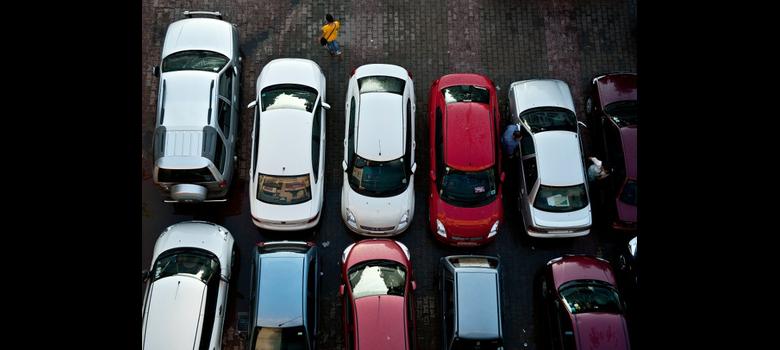 Incidents of violence and scuffles because of parking spats have become more common as the number of cars on Delhi's roads continues to grow.

“The research clearly shows that parking demand is insatiable. You can never satisfy the insatiable demand for parking. The city doesn’t have enough space to park the cars,” she said. “At one level we should be able to improve the alternative to park, we need to be improving public transport and at the same time you have to manage the usage of cars better. People must pay the right price for using the roads and using public space.”
Incidents of violence and scuffles because of parking spats have become more common as the number of cars on Delhi's roads continues to grow.
Rajender Bhatia was sitting in his ground floor apartment in central Delhi on Sunday morning when his neighbour turned up. Kartik, who lived on the second floor of the same building, had come to pick a bone with Bhatia about the parking situation around their building. The argument quickly escalated and, according to the police, a couple of other men also joined the fracas that turned into a proper scuffle.
Then suddenly the 55-year-old Bhatia collapsed, prompting the others to run away and his family to take him to the hospital. The doctors there declared Bhatia dead on arrival and a case was registered against Kartik and the other men, who have since been arrested and booked with culpable homicide not amounting to murder.
Bhatia, unfortunately, is not the first to have died in an argument over parking in Delhi: there have been seven other violent incidents related to it this year alone. And, considering the state of parking in the capital, it’s unlikely Bhatia’s case will be the last.
Police records suggest that 15 people have died in the capital over parking-related issues in the past five years, with many more incidents of violent clashes. Other than the capital’s generally high stress levels, which have given it the reputation of being particularly prone to violence and spats, the huge number of cars being added to the roads combined with limited space is mainly what is behind this unique category of crimes. It isn’t uncommon to see car tires being slashed or a parked car being keyed by angry residents who see it as a way to complain about parking.
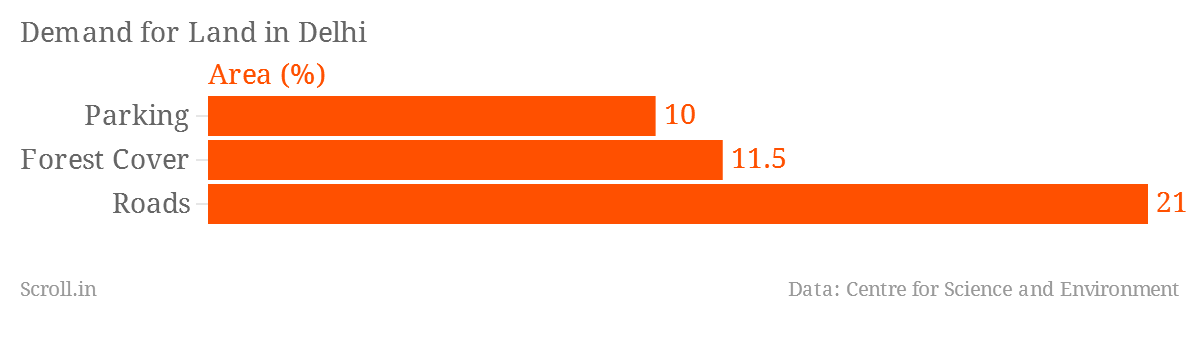
The problem according to urban planning experts, however, isn’t one of inadequate space for parking. A 2009 study carried out by the Centre for Science and Environment concluded that, based on standards laid down by the Delhi government, about 10% of all land in the capital is used by stationary vehicles — just a little less than the forest cover in the city, which is about 11.5% of all land.
Instead, it is a question of incentives and planning. Delhi gives far too much leeway to car drivers even though under 15% of all trips in the capital happen in cars, with the metro, buses and other modes of transport moving much more of the city’s population around.
Yet much of the city has completely free parking — using public land that could otherwise have been given over to other uses — and in the places where you do have to pay to park, the revenues don’t even come close to what the land might otherwise be able to generate.
“Today parking policy in Delhi is only about supplying parking space, all the building bylaws and everything is all about providing space for parking,” said Anumita Roy Chowdhury, executive director at the Centre for Science and Environment. “People have begun to think as if parking is their right that the government should provide for, which is absolutely wrong.”
The city’s transport policy is also terribly weighted in favour of car drivers, as the cancellation of the Bus Rapid Transit corridor showed. The city expects up to 69 sq m to be available to a single car per day, presuming it will park in at least three different places, compared with its standard allotment of just 25 sq m houses for the poor.
“Delhi, in other words, allots more public land per day for parking cars than it does to house its poor. And all this for only 20 per cent of city's population that has a family car, based on figures of the 2008 Household Survey by the Department of Transport,” wrote the Unified Traffic and Transportation Infrastructure (Planning and Engineering) Centre, in a study in 2010.
A study by the Central Road Research Institute also pointed out that the average car stays parked for more than 95% of the time. Yet policy favours cars, provides cheap parking and encourages the buying of vehicles to the extent that car owners have come to expect convenient places to park — something that will be harder and harder for the capital to provide every year to come.
A change in the nature of residential areas is also playing a huge part. As car ownership per person grows, it has become common to see roadsides not meant for parking being occupied by vehicles of all sorts. This ends up obstructing carriageways and entrances, increasing frustration among residents and leading to incidents like Bhatia’s.
“Numerous disputes over parking in residential neighbourhoods with serious law and order consequences have become common in Delhi,” the CSE study into parking policy pointed out. "Parking in residential areas is not managed well, norms are not enforced. Most of the time it is left to the vagaries and negotiating skills of individual car owners. In many residential areas, one is free to park as many vehicles as one wishes on the road and that too at no cost.”
Roy Chowdhury said that it was this conditioning, leading car owners to believe they deserve a parking spot by right, that leads to confrontation and violence when they don’t get it. Because supply is finite, however, she argues that the only way to deal with it is to change the way people think about parking.
“The research clearly shows that parking demand is insatiable. You can never satisfy the insatiable demand for parking. The city doesn’t have enough space to park the cars,” she said. “At one level we should be able to improve the alternative to park, we need to be improving public transport and at the same time you have to manage the usage of cars better. People must pay the right price for using the roads and using public space.”


Thursday, July 3, 2014
Google Removes Robert Peston's BBC Article Because Someone Wanted It 'Forgotten'
Instead of being 'forgotten', the item has been re-tweeted many, many times!
From: http://www.huffingtonpost.co.uk/2014/07/03/google-right-to-be-forgotten-robert-peston_n_5553880.html

From: http://www.huffingtonpost.co.uk/2014/07/03/google-right-to-be-forgotten-robert-peston_n_5553880.html
Robert Peston woke up to an eyebrow-raising email from the search engine giant this morning, informing him his work had been eradicated from history, complying with new measures that require sites to honour the "right to be forgotten" online.
His blog post about former Merrill Lynch boss Stan O'Neal, published almost seven years ago on the BBC website, is now unsearchable in Google. Peston said that this effectively means that no one will see the blog post from now on.
“To all intents and purposes the article has been removed from the public record, given that Google is the route to information and stories for most people,” he wrote.
The reporter has now asked why he was being "cast into oblivion" by the search engine.
A landmark European court decision in May said Google must listen and sometimes comply when individuals ask it to remove links to newspaper articles or websites containing personal information.
The "right to be forgotten" is based on the premise that outdated information about people should be removed from the internet after a certain time.
Google sent Peston the following message:
Notice of removal from Google Search: we regret to inform you that we are no longer able to show the following pages from your website in response to certain searches on European versions of Google
Perston's article described how O'Neal was forced to leave the investment bank after it endured significant losses on the back of careless investments.
Blogging on the matter yesterday Peston accused Google of having "killed this example of my journalism", but conceded that the technology giant had opposed the court ruling.
The latest blog, which links to the 2007 article, was last night shared on Peston's Twitter feed and retweeted more than 500 times.
The journalist said he did not know who had requested the removal of the story, entitled "Merrill's mess", from the search engine, declaring it "all a bit odd".
He said: "Maybe I am a victim of teething problems. It is only a few days since the ruling has been implemented - and Google tells me that since then it has received a staggering 50,000 requests for articles to be removed from European searches."
Speaking shortly after the ruling in May, Google spokesman Al Verney said it was ''disappointing ... for search engines and online publishers in general''.
Peston, who said he was "rather shocked" to be told that the article was being removed from search results, said that it was "completely possible" the complaint could have come from any of the readers who commented on the post or were named in the comments, rather than in the story itself.
But the journalist said it was still possible to find web pages Google had been asked to remove from European searches.
He told BBC Radio 4's Today programme: "Because this only applies in Europe, because this is an EU ruling, if you put in google.com/ncr that basically means you are not searching the regional version of Google and even if you are in the UK you can still find anything.
"So it sort of makes a whole nonsense of the ruling, to be honest."
Google informed Peston that since the rule came into force it has received around 50,000 removal requests, and that it has hired "an army of paralegals" to process them. Peston has contacted Google to ask if he can appeal against the blocking of his article. He is currently awaiting a response.
Wednesday, March 26, 2014
China's 2nd-child policy hurts female job application
From: http://www.chinadaily.com.cn/china/2014-03/26/content_17380743.htm

 The photo taken on Mar 5 in Fuzhou, Fujian Province, shows women are looking for opportunities at a job fair. The second-child policy may make it harder for married women to find a job.[Photo/chinanews.com] |
China has loosened its family planning policy by allowing couples to have a second child if either parent is an only child. Unfortunately, the policy has resulted in discrimination against some married women who are looking for jobs or are already employed, according to the Xinhua News agency.
Xia Fang, a Changsha local who gave birth to her first child 10 months ago, said that during job interviews she is always asked if she is an only child or if she plans to have a second child.
"I don't plan to have a second child. But when potential employers learn that my first child is a girl, they think I'm likely to have another baby," said Xia.
Before the second-child policy was introduced, married women with children and work experience had an advantage in the job market, but now they are being confronted with gender discrimination again, Xia added.
Female employees of child-bearing age are being affected, as well. A white collar worker surnamed Liu said she was passed over for a promotion that went to a young man, because her boss thought she might plan to have a second child.
"Women have to work harder to be given equal status in the workplace. And many face pressure from their families to have second children, which can affect their career prospects," Liu said.
"Companies can predict the cost of a female employee's maternity leave when they're allowed to give birth to only one child," said Li Bin, a professor of sociology at Zhongnan University. "But some middle and small-sized companies can't bear the costs of two leaves in a few years."
Ms. Wang, an HR manager at a company, said the second-child policy revealed the disadvantages of female employees in the workplace, while giving male workers more advantage. "With two children, men suffer more life pressure, but that will motivate them to work harder."
"Giving birth to children is a social responsibility that should not be shouldered by women alone," said Li Bin.
China has yet to release specific laws on gender discrimination in the workplace.
Sunday, March 2, 2014
Chinese Employers Discriminate Against Women Planning to Have Two Children
From: http://www.businessweek.com/articles/2014-02-28/chinese-employers-discriminate-against-women-planning-to-have-two-children
Late last year, China’s central government announced reforms to the controversial one-child policy—in particular, approving a resolution that would allow couples to have two children if at least one of the parents was an only child. But the change didn’t go into effect instantly; implementation is controlled locally. On Tuesday,Shanghai’s government approved measures to enact the so-called two-child policy, effective March 1. Shanghai is the seventh region in China to adopt guidelines for reforming, not abolishing, the country’s sprawling population-control bureaucracy.
To some extent, the number of children couples can have—and when they can have them—will vary by city. Shanghai’s policies are more liberal than Beijing’s, where new guidelines took hold last Friday. Shanghai parents qualified to have two children can do so regardless of their own ages or the time between births. But Beijing parents with one child must wait until the mother turns 28, or the first child turns 4, before having a second child, as independent newsmagazine Caijingreported.
China’s relaxed birth-control policies also bring unexpected consequences. According to state-run Global Times, some female job applicants are already facing increased hiring discrimination as potential employers appear reluctant to pay for two maternity leaves. “An interviewer asked me if I was going to have two children, and I did not know how to answer,” one young woman in Zhejiang province told the newspaper. “Having children is also making a contribution to society, but they [potential employers] treat us like enemies, which is so unfair.”
Subscribe to:
Posts (Atom)