Friday, March 15, 2013

UK 'whiplash capital of Europe'

The UK passed a law several years ago allowing lawyers to charge on results rather than a fee based on time spent.  Unfortunately, amongst many other unintended consequences is this one.


From: http://www.telegraph.co.uk/finance/personalfinance/insurance/motorinsurance/8522985/UK-whiplash-capital-of-Europe.html

Insurers have called for a clampdown on fraudulent whiplash claims which they say are driving up the cost of motor cover for honest motorists.

Rear-end shunts often result in costly claims for whiplash
Rear-end shunts often result in costly claims for whiplash Photo: ALAMY
The Association of British Insurers (ABI) said the UK was now the "whiplash capital of Europe", with one out of every 140 people claiming for a whiplash injury each year.
It said the activities of ambulance chasing lawyers and claims management firms, as well as staged "cash for crash" accidents, were driving up the number of claims.
Whiplash occurs when the soft tissue in the spine is stretched and strained following a sudden forceful movement, such as being hit from behind in a car.
But it is often difficult to diagnose, while it is easy to fake or exaggerate, making claims for the injury a target for fraudsters.
Around 1,200 whiplash claims are made in the UK every day, six times more than the number of people who claim for workplace related injuries each year.

Record number of Americans buying guns, new FBI figures show


From http://www.guardian.co.uk/world/2013/feb/05/fbi-us-gun-control-record-number-buying

More than 2.4m gun background checks were initiated in January, topped only by last December's 2.7m

guns US
'America is crazy for guns,' says Pam Bosley, mother of a young student shot dead in Chicago. 'We love guns more than life.' Photograph: Elaine Thompson/AP
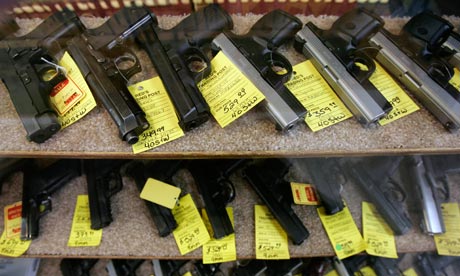
Americans are lining up to buy guns in unprecedented numbers in the wake of the Newtown school shooting and the debate around tightening gun controls, with federal background checks on prospective buyers running at record levels.
New figures released by the FBI show that 2,495,440 gun background checks were initiated in January. That is the second highest number since records began in 1998, and is exceeded only by the entry for December 2012, which reached a peak of 2,783,765.

Beans means bonanza as oil frackers turn demand for guar into gold rush


The Times: "Just as America’s booming shale gas industry has helped to wean the country off an unhealthy dependence on imported Middle Eastern oil, a new national addiction is emerging — to the Indian guar gum on which the industry depends.
A merchant paints numbers on sacks of guar as a laborer loads them onto a truck at a grain market in Jodhpur, India

Soaring demand for guar from US oil companies — whose apparently insatiable appetite stems from its use in making the drilling fluids used in the process of hydraulic fracturing or “fracking” for shale gas — triggered a 374 per cent surge in Indian exports between January 2011 and January 2012.
With 80 per cent of global production of guar — which means cow feed in Hindi — India has a near monopoly on the bean, a fact that has led to a bonanza for Indian farmers who witnessed a ninefold increase in prices during 2012. “The price increase has been just astronomical,” says Naveen Mathur, commodities analyst at Angel Broking in Mumbai.

For decades, apart from cow feed, powdered guar has been used as a thickener in toothpaste, pet food and ice cream, but global demand has mushroomed in recent years because oil companies such as Halliburton and Schlumberger have required huge quantities for use as a thickening agent in the fluid needed to squeeze shale gas out of rock formations deep underground.

Almost overnight, guar has become India’s biggest agricultural export, shipments of which were worth $4.9 billion between April and January 2012, roughly double the value of the country’s exports of basmati rice and cotton combined.

Like the Texan oil booms of the 19th century, the guar rush is having a similar effect on the desert state of Rajasthan, where most of it is grown and where some farmers have earned more in a single season than the previous ten put together.

Guar beans, which are milled and powdered to produce gum that is eight times more viscous than cornstarch, grows only in rare climatic conditions — arid areas watered by intermittent but heavy monsoon rains.

But the huge surge in prices and exports has prompted some to ask whether the boom can last.
As Indian farmers frantically plant new areas to meet demand, US oil scientists in Houston are desperately trying to come up with synthetic alternatives, such as carbon methyl cellulose, which could rival guar on both price as well as efficacy.

Others are trying to develop new strains of guar that can be grown in different climatic conditions.

So far, they have not managed to do so — and India’s guar boom looks set to continue.

Wednesday, January 23, 2013

Corruption curbs crimp luxury market


From China Dailyhttp://www.chinadaily.com.cn/china/2013-01/17/content_16128533.htm:
Government moves to fight corruption will have some surprising effectsincluding putting a possible dent in the market for luxury goodsas Wang Wen finds out.
Strict government regulations to ban officialsconsumption of luxury items are expected to soften the luxury goods market and change patterns of consumer consumption.
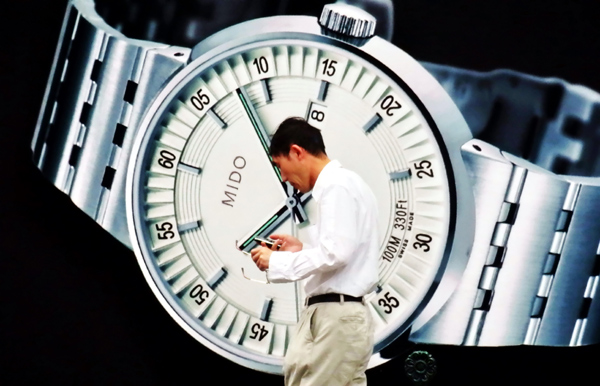
Statistics from the Federation of the Swiss Watch Industry show that Swiss watch exports to the Chinese mainland dropped 27.5 percent year-on-year in September.
Corruption curbs crimp luxury market
A pedestrian walks by a Swiss watch advertisement in downtown Shanghai in September 2011. JingWei / for China Daily
China's demand had been weakening through the yearbut September was the worstfollowed by another 12.3 percent fall in Octobernoted Ren Guoqianga partner at Roland Berger Strategy Consultants in Chinaa consulting firm based in Germany.
Ren said government officialswho used to be the main recipients of luxury watches as gifts,were unsure about the future policy environment.
Several government officials who were noticed by the public to own luxury watches were investigated for corruption in 2012. One was the director of the provincial administration of work safetywho wore a Swiss watch when appearing at the site of a highway accident.
Officials are cautious now about receiving giftsRen said.
"It hurts the luxury watch business a lot," since more than 25 percent of the luxury items sold on the Chinese mainland were used as gifts.
The government has made a new regulation banning government officials from using public funds to buy luxury itemsThe regulation was made in July and came into effect in October.
The regulation specifically restricts buying luxury items as giftsespecially products such as men's watches and garmentssaid Bruno Lannesa partner of Bain & Coa consultancy based in the United States.
Bain & Co shows that the yearly sale of luxury watches would fall 5 percent on the Chinese mainland in 2012, whereas in 2011 the figure rose as much as 40 percent.
Domestic distributors were also hit.
"The ban will have an adverse effect on our watch sales," said Sun Xuguangthe operations manager at Sparkle Roll Group Ltda Hong Kong-listed luxury dealer of Swiss independent watch brandsincluding Parmigiani and DeWitt.
Very high-end watches are eye-catching and easily recognized by the public and so will be affected moreSun added.
The recent ban on public money for luxury goods has had an impact not only on salesbut also on consumer trends.
Buying giftswhich will remain an important part of luxury spendingis moving away from items with logos due to the extensive exposure on social mediasaid Lannes.

Thursday, January 17, 2013

United States and Japan began on Thursday the revision of defense cooperation guidelines


We hope that this revision does not fall onto the 'Law of Unintended Consequences' and exacerbates rather than alleviates the current high tensions.

Reuters: "The United States and Japan began on Thursday the revision of defense cooperation guidelines for the first time in 15 years as Prime Minister Shinzo Abe faces a territorial dispute with China and North Korea's missile and nuclear programmes.
Shinzo Abe
The revision to the guidelines, which set rules on how Japanese and U.S. forces work together in or near Japan, comes after a hawkish Abe led his Liberal Democratic Party to power in an election last month.
"We would like to discuss Japanese Self Defence Forces' role and U.S. forces role with eyes on the next five, 10, 15 years and on the security environment during those periods," a Defence Ministry official told reporters, without elaborating.
The revision is due because of drastic changes in the security environment over the past 15 years including China's maritime expansion and North Korea's missile development, the Japanese government has said.
North Korea has also twice tested nuclear devices.
Japan is locked in a territorial dispute with China over a group of tiny East China Sea islets called Senkaku in Japan and Diaoyu in China, with both countries sending patrol ships and planes to areas near the isles.
The review started with a working-level meeting in Tokyo between U.S. and Japanese officials. It will likely take a year or more to complete and coincides with a U.S. "pivot" in diplomatic and security focus to Asia.
"One issue that's prevalent is whether the Abe government will reinterpret the constitution to exercise the right of collective self defence," said Nicholas Szechenyi, senior fellow at the Center for Strategic and International Studies.
"Should that policy decision be taken, it will obviously have an impact on the way the Self Defence Forces and U.S. military coordinate."
Japan recognizes it has what is known as the right of collective self-defence, meaning a right to defend with force allies under attack even when Japan itself is not being attacked.
But Japanese governments have traditionally interpreted the pacifist constitution as banning the actual exercise of the right, creating a sore spot in Tokyo's security ties with Washington. Abe wants to change the interpretation to allow Japan to exercise the right.
See also: http://chindia-alert.org/2012/08/12/beijing-reasserts-its-claims-in-south-china-sea-nytimes-com/

Monday, January 14, 2013

United States, China, and India: Unintended consequences of great power politics


Author: Franz-Stefan Gady is a Senior Fellow at the EastWest Institute.
China India Map
October 2012 marked the 50th anniversary of the 1962 Sino-Indian War. Communist China launched a surprise attack across the Himalayas to “teach India a lesson”, according to the Chinese Premier, Zhou Enlai. 
After 32 days of fighting and embarrassing Indian defeats, the Chinese announced a unilateral ceasefire and withdrew behind the McMahon Line (the de-facto boundary between China and India, although legally disputed by the People’s Republic of China).
To this day, the 1962 war is seen as a national humiliation in India
Scanning the Op-Ed sections of newspapers while I was in New Delhi in October this year, the general consensus of commentators and political analysts appeared to be that the war, like no other event in post-colonial Indian history, was a unifying force in bringing the country together. It led to the modernization of the Indian Army, and made India temporarily abandon its isolationist, non-aligned foreign policy outlook, and forced it to accept military aid from Western Powers and the Soviet Union, ultimately setting the stage for a more assertive Indian foreign policy.
India’s slow ascent to great power status
Diplomatic historians may mark the 1962 war as the beginning of India’s slow ascent to great power status and a force to be reckoned with in 21st century Asian power politics. Yet, to this day, India’s foreign policy is – more than most other emerging titans – constrained by a quest for internal security and a deep introspection – making it a reluctant power and conducting a more or less “introverted foreign policy”.
Checking the growth of Chinese power in the region
The United States is trying to change India’s reluctant stance and is attempting to forge closer ties with New Delhi. During his visit in June 2012, U.S. Secretary of Defense, Leon Panetta, called India a “lynchpin” in the United States’ strategic pivot to Asia.
Behind all of this is the United States’ desire to check the growth of Chinese power in the region.  As the former US Envoy to India, Robert D. Blackwill, pointed out in a speech in New Delhi in 2009: “President George W. Bush based his transformation of US-India Relations on the core strategic principle of democratic India as a key reason in balancing the rise of Chinese power.” Also he noted that: “[W]ithout this China factor at the fore in Washington, in my view the Bush Administration would not have negotiated the Civil Nuclear Agreement and the Congress would not have approved it.”
“Be careful what you wish for”
Yet, the United States should heed the maxim “be careful what you wish for.” For closer military and diplomatic ties between India and the United States may embolden India’s foreign policy, which could potentially destabilize the entire region of South Asia. As history teaches us, multi-cultural great powers often have a need to define their national identities by overarching national ‘exertions’ such as a war.
The current Indian National Security Advisor Menon referred to India as a ‘bridging power’ during an interview with Robert D. Kaplan  for his book, Monsoon: The Indian Ocean and the Future of American Power.
Kaplan describes Menon’s rationale behind this statement: “[India]is something between America and China, between a global power and a regional power, between a hard and soft power, between the emerging power of its economy and navy, and the poverty of its people and its weak borders.” Substitute India for Austria in the early 20th century and you have a historical case study of what the unintentional consequences of closer diplomatic ties with the supreme military of its time could entail.
India as ‘bridging power’?
The Austrian Empire, like India, was considered to be a bridging power between East and West for much of its existence. It was a multi-national empire, more concerned with its internal security and stability than with great power politics, and after humiliating defeats in 1859 and 1866, reluctant to use military power to meet its political goals (for most of the late 19th century-early 20th period it spent comparatively little on military defense).
As in the Sino-Indian war of 1962, these defeats lead to various military and political reforms culminating in the Austro-Hungarian compromise of 1867 and the establishment of a dual monarchy. Also, like India, Austria-Hungary was held together by an omnipotent, if slightly inefficient, bureaucracy.
Austria’s “Pakistan” in the 20th century was Serbia
Serbia, a small state in the Balkans trying to lure the South Slavic subjects of the empire to revolt through subversive means (as with Pakistan there was a clandestine connection between government circles and radical elements in the Serbian intelligence community).
Most importantly, Austria’s stance vis-à-vis Serbia was emboldened by its dual alliance with the German Empire, which in 1914 , after the assassination, gave Austria a diplomatic “Carte Blanche”, to deal once and for all with the “Serbian problem”.
Before this dual alliance, Austria always had to play a rather careful diplomatic game between East and West. The great protector power of Serbia was Russia, Austria’s powerful eastern neighbor threatening Austria’s exposed eastern borders. As the years progressed and tensions between the great powers mounted and the dual alliance solidified, Austria took an increasingly more aggressive stance against Serbia’s agitations.
In 1914, after the assassination of Archduke Ferdinand of Austria, Austria’s Chief of Staff, Conrad von Hoetzendorf’s, repeated requests for preventive war with Serbia was finally granted.  Not before Austria, however, thought it had secured Germany’s guarantee to help defend its eastern borders, plunging all of Europe in the First World War.
India with similar problems?
India today faces many similar problems as Austria did in the early 20th century. A powerful peer competitor in the East (China) is conducting a relatively subtle anti-Indian South Asian policy and a smaller, but the more real subversive threat is coming from Pakistan and from continuing internal unrest in India.
Add the world’s strongest military power to this mix and the results could be explosive. According to various foreign policy experts in New Delhi, India is very aware of the delicate situation it occupies.
The United States would do well not to foster too close of a tie with India in the next few years of its strategic re-alignment to Asia. India has cautiously positioned herself between both parties in US-China competition. China has made it clear in many statements that it is not a threat to India, where India’s defense ministry clearly stated that India is not interested in containing China.
India’s diplomacy of peace and non-alignment is deeply felt and comes more naturally to it than war.  In the near term the bigger danger of an emboldened India may well be an increase in crypto-nationalism and inter-communal extremism.
The Obama Administration should nevertheless carefully evaluate its relationship with India in the next four years and beware of the unintentional but often hazardous consequences of Great Power politics.

Thursday, December 20, 2012

Reduced overtime at Foxconn upsets migant workers


An unintended consequence of enforcing 'fair' worker treatment - reduced income for migrant workers more than willing to work excessive overtime!


 "Nets to catch would-be jumpers still sag ominously from Hon Hai Precision Industry Co.'s  buildings.

But two years after a spate of suicides at the Apple Inc.  supplier's campus here, workers are more concerned about another measure designed to protect them: limits on overtime.

Hon Hai in March said it would change its workplace practices after an audit by a U.S.-based nonprofit worker-safety group found widespread breaches of Chinese law and Apple policies at three plants, including the excessive use of overtime. Hon Hai responded by pledging that it would bring its overtime policies into alignment with Chinese law by next year, allowing workers to work no more than nine hours of overtime a week. 

The Taiwan-based company, also known as Foxconn, pledged to improve health and safety conditions at its campuses across China as well.
But more than 15 workers on the Shenzhen campus said in interviews that they work more than the legal limit of nine overtime hours a week. A majority said they work 10 to 15 overtime hours and would prefer more, having left their distant homes to make money in this southern Chinese boomtown on the border of Hong Kong.

"I think a lot of the more experienced people from the technology production lines will leave" if the policy to limit overtime goes into effect, said a worker who asked to be identified only by his surname, Ma. "We don't know how much our salary will go up. But after being here three years, I don't have much incentive to stay, since my wage probably won't rise much."
Mr. Ma, who earned roughly 3,400 yuan ($540) a month including overtime when he arrived three years ago, said he now earns about 5,000 yuan. To make extra money, the 26-year-old buys used car parts cheaply on an e-commerce website and then resells them.

Basic pay at the Shenzhen Longhua plant is 2,200 yuan, before overtime.

Keeping Mr. Ma and its 1.5 million other Chinese workers satisfied, while manufacturing complex, time-sensitive consumer electronics profitably is becoming more challenging for Hon Hai. The company's labor costs will rise by roughly $1.4 billion when the new labor policies roll out next year, according to a Bernstein Research estimate. Hon Hai's operating profit margin had declined since the second quarter of 2010 because of rising wages. The figure rose to 3.4% in this year's third quarter from 2.2% a year earlier as the company raised what it charged customers, analysts said.

Hon Hai isn't alone in facing such challenges. Employee protests over working conditions and the willingness of staff to change employer for more pay have forced electronics manufacturers to raise wages throughout China. Hon Hai and other companies have moved some operations to countries such as Vietnam and Mexico, where costs for labor or transportation to end markets are lower."